MuddyWater's Double Game: Iran's Cyber Unit Trades Precision for Reach- 213
June 28, 2026
An intrusion that looks like a ransomware shakedown and a breach wave spanning nine countries on four continents would, on their own, read as two unremarkable entries in the cybersecurity trade press. Placed side by side, they reveal something else: an Iranian intelligence unit quietly rewriting its own playbook, learning to wear the mask of ordinary cybercrime in one operation while, in another, scaling its technical reach across a widening map of industrial and government targets. Two threat-intelligence disclosures published within weeks of each other in early 2026 describe, from different vantage points, the same actor mid-transformation.
MuddyWater, the Iranian intrusion set tied by Washington to the Ministry of Intelligence and Security since 2022, no longer resembles the narrowly targeted espionage unit first identified in the Middle East in 2017. What emerges once the two reports are read together is a group that has learned to borrow the aesthetics of cybercrime while simultaneously scaling its technical reach across continents.
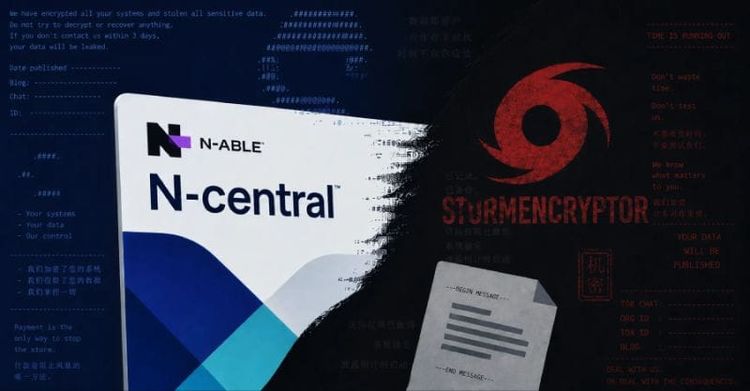
The first thread, surfaced by Rapid7, concerns an intrusion that began, by every visible marker, as an ordinary ransomware case. Employees were approached over Microsoft Teams by attackers posing as internal IT staff, coaxed into screen-sharing sessions, and persuaded to type credentials into local text files — the now-familiar social-engineering script that has become MuddyWater's signature entry vector. What followed looked at first like a textbook affiliate of the Chaos ransomware-as-a-service brand: extortion emails, a listing on Chaos's leak site, threats to publish stolen data. But no encryption payload ever appeared, and the ransom note the attackers claimed to have left behind could not be found. Rapid7's investigators concluded the ransomware theater was never the objective — it was cover, a way of redirecting incident responders toward a financially-motivated narrative while the actual work of espionage, conducted through remote access tools like AnyDesk and DWAgent, proceeded underneath. It would not be the first time; MuddyWater had adopted the same misdirection the previous year via the Qilin ransomware brand, after an earlier operation against an Israeli hospital had been publicly attributed to Tehran.
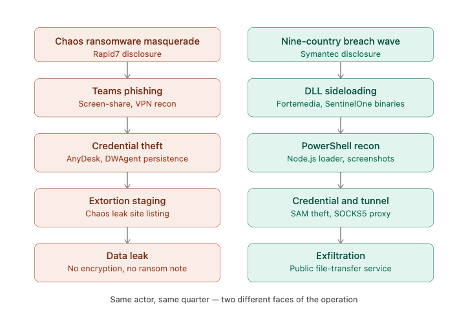
The second thread, documented separately by Symantec, describes a campaign of a different character entirely: not a single disguised intrusion but a sprawling wave, striking at least nine organizations across nine countries and four continents in the first quarter of 2026. Victims spanned a major South Korean electronics manufacturer, industrial firms in Southeast Asia, and institutions in education, government and finance. Here the tradecraft was technical rather than theatrical — MuddyWater sideloaded malicious code through legitimate, signed binaries from vendors including Fortemedia and SentinelOne, then used a Node.js-based loader to run PowerShell scripts for reconnaissance, credential theft, and the establishment of covert proxy tunnels. Exfiltration relied not on custom infrastructure but on a public file-transfer service, blending stolen data into ordinary consumer traffic. Symantec's researchers characterized the intrusion into the Korean manufacturer's network — sustained for roughly a week before detection — as consistent with implant-driven persistence rather than continuous hands-on operation, a mark of an actor comfortable leaving automated footholds in place across a widening set of targets.
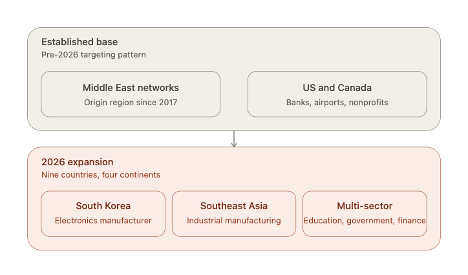
Read side by side, the two disclosures describe less a single campaign than a doctrine. MuddyWater is simultaneously investing in narrative misdirection, adopting criminal branding precisely because attribution to Iran now carries diplomatic cost, and in operational scale, extending its reach into sectors and geographies — East Asian manufacturing, Southeast Asian industry — that sit outside its traditional Middle Eastern and Western government targeting. The two postures are not in tension; they serve the same end. A ransomware label slows defenders down and complicates public attribution, buying the time an expanding, implant-heavy footprint needs to mature undetected. For an intelligence service under sustained scrutiny since the 2022 US Cyber Command designation, blurring the line between state espionage and ordinary cybercrime is not a lapse in tradecraft. It is, increasingly, the tradecraft itself.