The Edge Infrastructure Peril: Tracking the Corporate-State Botnet Evolution-160
May 20, 2026
The line between civilian digital infrastructure and state-sponsored battlefields has officially dissolved. As detailed by a coalition of international intelligence agencies, advanced cyber espionage actors linked to the People’s Republic of China (PRC)—such as Flax Typhoon—have executed a massive doctrine shift away from traditional, easily trackable command-and-control servers. Instead, they are systematically hijacking millions of everyday consumer, home-office, and enterprise edge devices, including routers, IoT cameras, and network-attached storage appliances. This strategy fuses high-level geopolitical ambition with technical camouflage, routing fragmented malicious data packets seamlessly through residential neighborhoods worldwide. By turning ordinary civilian hardware into an "elusive transit layer," these threat actors achieve total plausible deniability, neutralize legacy Western perimeter defenses, and covertly pre-position themselves within critical infrastructure, fundamentally altering the economics and tracking of modern cyber warfare.
This strategic assessment synthesizes the systemic shift in cyber warfare methodologies deployed by state-aligned actors operating out of the People’s Republic of China (PRC), integrating technical indicators with high-level geopolitical motivations.
The threat landscape has crossed a critical structural threshold. Joint intelligence and operational findings from the US Cybersecurity and Infrastructure Security Agency (CISA), the Federal Bureau of Investigation (FBI), the UK’s National Cyber Security Centre (NCSC), and international counterparts reveal a deliberate departure from traditional, centralized state-sponsored cyber operations. Advanced Persistent Threat (APT) groups, specifically those clustered under designations like Flax Typhoon and Volt Typhoon, are systematically abandoning the procurement of legacy, dedicated server architectures and registered domain infrastructure. Instead, they are substituting these predictable footprints with an industrialized, highly resilient "elusive transit layer" built natively into the fabric of the global civilian internet.
This operational doctrine moves far beyond standard botnet activity. It relies on the mass, automated exploitation of internet-facing edge devices, utilizing vulnerable consumer, small-office/home-office (SOHO), and enterprise equipment. The targeted hardware matrix specifically weaponizes home routers, smart IP cameras, digital video recorders (DVRs), network-attached storage (NAS) appliances, and peripheral internet-of-things (IoT) devices. By exploiting unpatched vulnerabilities—particularly on "End-of-Life" (EOL) hardware that is no longer monitored or updated by manufacturers—the threat actors construct dynamic, self-healing proxy networks capable of scaling to hundreds of thousands of concurrent nodes globally. A prominent manifestation of this model is the "Raptor Train" botnet framework, which infected over 200,000 devices worldwide before international disruption efforts intervened.
The intersection of this technical shift with high-level geopolitical strategy is profound. By utilizing an infrastructure layer managed and optimized by commercial, state-linked entities—such as the Beijing-headquartered and EU/US-sanctioned Integrity Technology Group—the Chinese state effectively privatizes and scales its offensive cyber logistics. This approach achieves several crucial geopolitical objectives simultaneously. First, it affords Beijing a durable layer of plausible deniability. Because the malicious data packets are fragmented, distributed, and bounced across an endless stream of legitimate domestic and residential IP addresses worldwide, origin tracing becomes functionally impossible. This minimizes the diplomatic and economic fallout traditionally associated with direct attribution. Second, it shifts the operational objective from immediate, loud intrusion or intellectual property theft toward long-term strategic pre-positioning and survivability. This infrastructure is meticulously engineered to remain covertly embedded within Western networks, ensuring that persistent access to critical national infrastructure, government systems, and defense networks remains functional and instantly ready to support broader influence or disruptive campaigns during periods of acute geopolitical crisis.
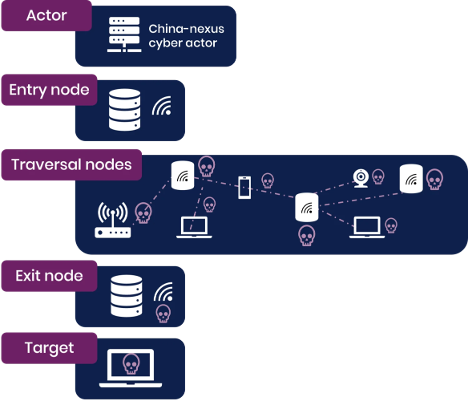
From an engineering and defensive perspective, this methodology effectively neutralizes legacy Western network defense paradigms. Traditional perimeter defenses, signature-based monitoring, and static IP blocklists are rendered entirely obsolete when an adversary's operational commands and data exfiltration paths look identical to routine domestic web traffic. Rather than acting as a simple egress point for data theft, these covert networks are integrated into the full lifecycle of the cyber-attack chain—including early-stage passive reconnaissance, continuous vulnerability scanning, and internal lateral movement. Because the traffic exits local nodes in the same geographic region as the intended target, perimeter anomalies are virtually invisible.
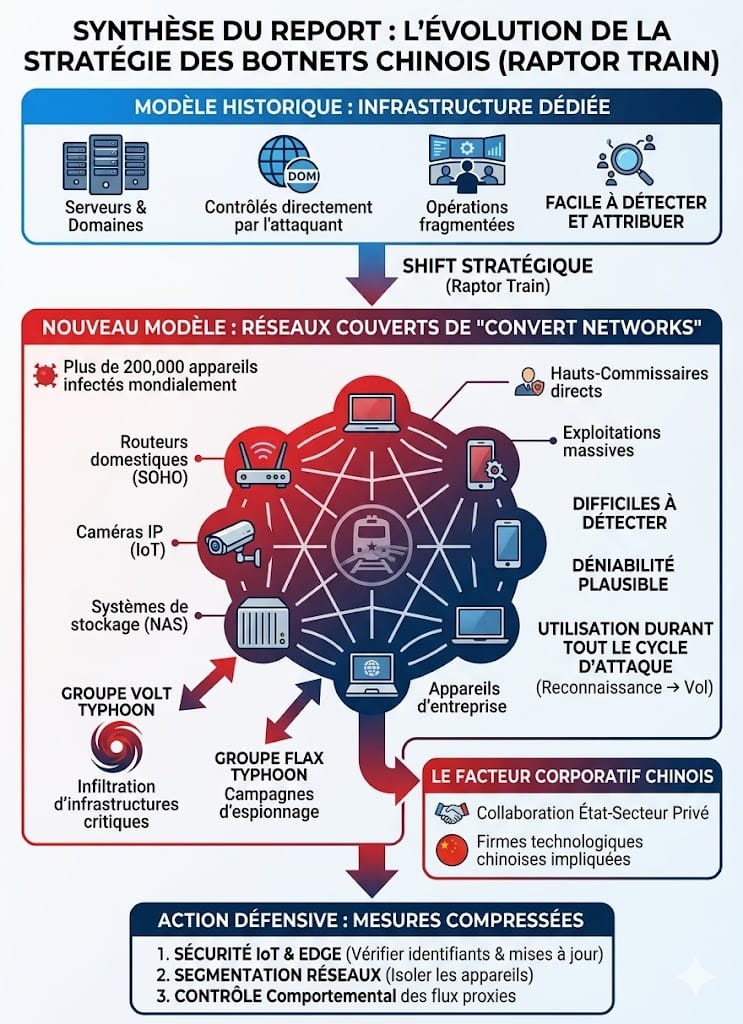
Countering an adversary that has seamlessly camouflaged its infrastructure within civilian internet architecture demands an immediate evolution in corporate and institutional defense. Reactive blocking must be replaced by rigorous zero-trust frameworks at the network edge. Organizations are forced to abandon simple perimeter assumptions, requiring machine certificates for all SSL/TLS connections, strictly allow-listing approved remote access vectors, and using advanced machine learning models to continuously profile and baseline normal network edge behavior. Furthermore, high-risk organizations must increasingly utilize NetFlow analysis to look upstream, actively mapping and hunting covert traversal nodes before they can establish connectivity with critical internal assets. The battlefield is no longer confined to isolated government networks; it has been permanently decentralized across the global consumer hardware ecosystem.