Turla's botnet redesign is about surviving disruption, not just evading detection- 240
June 28, 2026
Russia's FSB-linked Turla group has rebuilt its longstanding Kazuar backdoor into something structurally different from ordinary espionage malware: a modular peer-to-peer botnet where only a single elected node ever talks to the outside world, while every other infected machine communicates silently through encrypted internal channels. The redesign isn't primarily about evading antivirus signatures — it's an architecture built to survive exactly the kind of infrastructure takedowns that have ended so many previous Russian cyber-espionage campaigns.
Turla — tracked across the industry under a long list of aliases including Secret Blizzard, Snake, Uroburos, and Venomous Bear — has operated continuously since at least 2004, and CISA assesses the group as affiliated with Center 16 of Russia's Federal Security Service. Its targeting pattern has remained remarkably consistent over two decades: diplomatic missions, government ministries, and defense-sector organizations across Europe and Central Asia, with a notable secondary habit of piggybacking on access that other Russian-linked actors, particularly Aqua Blizzard, also known as Gamaredon or Actinium, have already established inside Ukrainian systems. That pattern — one FSB-linked unit reusing footholds another has already opened — points to a level of operational coordination, or at minimum resource-sharing, between distinct elements of Russia's state cyber apparatus that is easy to overlook amid the volume of individually attributed intrusions.
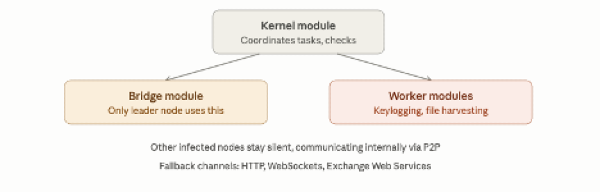
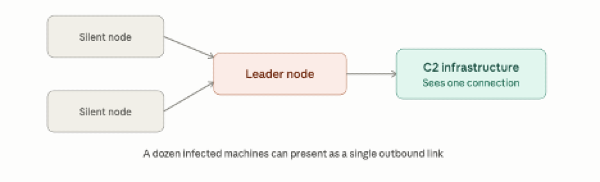
Microsoft's analysis of the upgraded Kazuar describes a three-module architecture built for resilience under pressure. A Kernel module functions as the command center, coordinating task distribution and running anti-analysis checks before the malware fully activates. A Bridge module serves as the sole communication gateway to external command-and-control infrastructure — but critically, only one elected "leader" node within an infected environment ever uses it; every other compromised machine stays in silent mode, exchanging data purely through internal peer-to-peer channels. Worker modules then handle the actual espionage tradecraft: keylogging, screenshot capture, email monitoring, file harvesting, and detailed system reconnaissance covering installed software, security products, USB devices, browser activity, and even DNS cache and PowerShell version data. The practical effect of routing all external communication through a single rotating leader is a dramatically reduced network footprint — from a defender's vantage point looking at network traffic, a dozen infected machines can present as a single outbound connection.
What makes this architecture specifically built for durability rather than just stealth is its redundancy at every layer. The Bridge module supports multiple fallback communication channels — HTTP, WebSockets, and Exchange Web Services — meaning disrupting one command-and-control method doesn't sever the botnet's connection to its operators. Structured messages built using Google's Protocol Buffers format let modules exchange commands and operational data efficiently regardless of which transport channel is active. Delivery itself is designed to defeat automated analysis from the outset: droppers decrypt their payloads only when running on an actual targeted system, and lightweight .NET loaders execute Kazuar's modules directly in memory, minimizing the file-based artifacts that traditional detection tools look for. Microsoft's own guidance to defenders reflects this shift in the malware's design philosophy directly — rather than chasing individual malware signatures, the more durable defense is watching for the behavioral fingerprints the architecture itself requires: leader election processes, inter-process communication patterns, staged working directories used to store collected data before exfiltration, and periodic, scheduled data transfers that don't match normal application behavior. A botnet engineered to survive the loss of any single node or communication channel requires defenders to think in terms of the system's behavior as a whole, not the malware sample sitting on any one infected machine.