Ten months in the dark: how a breach of South Korea's diplomatic training platform became a five-month secret before it became a public one- 279
July 23, 2026
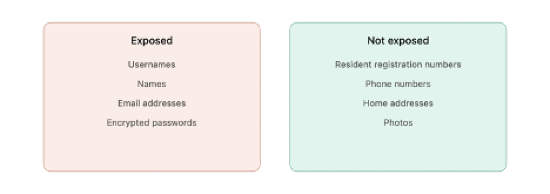
A cyberattack that began in April 2025 was still active in February 2026 before anyone at South Korea’s Foreign Ministry moved to shut it down — and even then, the public did not learn of it until late July. The breach itself, a compromise of the Korea National Diplomatic Academy’s online training platform, is in one sense a modest one: usernames, names, email addresses and encrypted passwords, not the more sensitive resident registration numbers, phone numbers, home addresses or photos that the ministry says stayed untouched. But the length of the intrusion, the profile of those affected, and the ministry’s own account of why it waited five months to say anything turn a comparatively contained data exposure into a case study in how a state actor handles the discovery of espionage against its own diplomatic corps.
The platform itself is a product of pandemic-era necessity — stood up in 2022 to deliver remote job training and language instruction to diplomatic personnel when in-person options were unavailable and left running ever since. That an e-learning system, rather than a classified network, became the entry point is unsurprising: training platforms sit lower in an institution's security hierarchy than its core diplomatic communications, yet they retain exactly the kind of personnel data — names, credentials, professional affiliations — that has lasting value for follow-on targeting. According to Dong-A Ilbo's reporting, roughly 10,000 current and former diplomats and officials seconded from other ministries had data exposed, a population that includes personnel currently stationed abroad, making the leaked account details a plausible foundation for future phishing or social-engineering operations against South Korean diplomatic staff rather than merely a closed incident.The ministry's own timeline invites more scrutiny than its statement addressed.
Spokesperson Park Il told reporters the intrusion was recognized in February 2026 but disclosed five months later, attributing the gap to the sensitivity of the matter for diplomatic and security affairs and the need for careful review. A second official went further, explicitly denying any connection between the delay and unrelated diplomatic developments, and instead attributing it to the technical complexity of the investigation and the need to coordinate across government agencies. The fact that officials felt compelled to preemptively rule out a political explanation suggests the delay itself had already become a subject of speculation before the ministry spoke — an unusual position for a government to find itself defending.
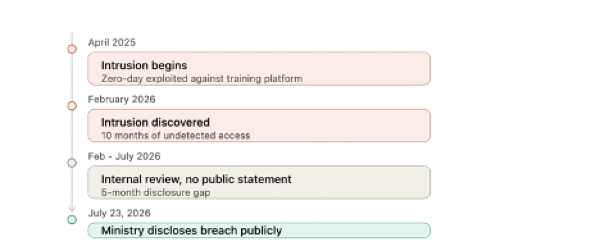
Attribution remains formally unresolved, but the technical signature is suggestive. The ministry has confirmed the attackers exploited a zero-day vulnerability to gain access, and security researchers have noted that this approach — targeting flaws in third-party software rather than the institution's own systems — is consistent with tactics previously associated with North Korean state-backed hacking groups. South Korean officials have stopped short of formal attribution, citing ongoing technical analysis, a caution that is standard practice but that also leaves the incident in the same gray zone that characterizes much state-linked cyber activity against South Korea: a plausible, pattern-consistent culprit, but no diplomatic or legal consequence attached to it. Ten months of unnoticed access to a system touching thousands of diplomatic personnel, followed by a further five months of non-disclosure, is itself a data point about detection capability and institutional risk tolerance — independent of who ultimately proves responsible.