Scaling the Scam: Inside One AI-Powered Compound While Washington Argues With Beijing- 313

August 5, 2026
A single disrupted network in a Cambodian border town and a Senate hearing three thousand miles away turn out to be describing the same problem from opposite ends. OpenAI's account of what it found running inside a scam operation based in Poipet shows, in granular detail, exactly what the State Department's own officials have been warning Congress about: criminal enterprises that have moved AI from a peripheral convenience into the operating system of the fraud itself. And the diplomatic response unfolding in Washington the very same week shows how far short of a real solution that recognition still sits, constrained by a Chinese government whose enforcement priorities protect its own citizens far more reliably than they protect anyone else's.
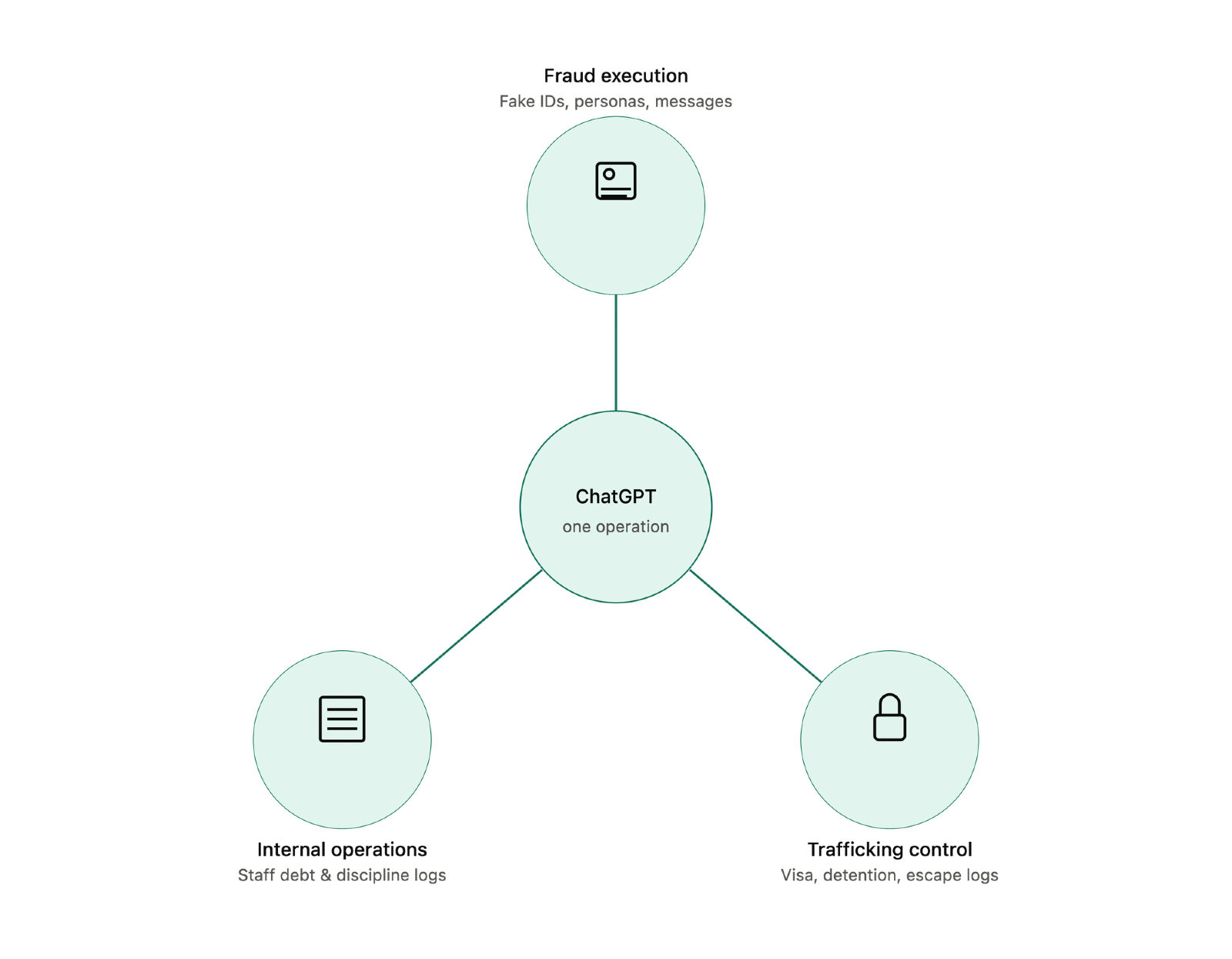
OpenAI's disruption, prompted by a tip from officials at WhatsApp, targeted a network in Poipet — a city with long-established ties to Chinese organized-crime scam operations — running investment fraud, romance scams, illegal gambling promotion, and impersonation of law enforcement officers, while separately using fake job advertisements to lure people in India with promises of free flights, accommodation, and work visas. What makes this case worth examining in detail is not any single scam type but the sheer breadth of functions ChatGPT had been folded into. The network used the model to build and maintain fake online personas, generate and translate messages sent directly to victims, produce promotional material for its fraud schemes, and fabricate convincing images of passports, legal notices, stock-purchase confirmations, and gambling-platform pages. Just as tellingly, the same tools were turned inward, toward running the operation itself: generating internal staff announcements, translating communication between employees, and — in a detail that reframes the entire case — maintaining records of employee debts, salary deductions, disciplinary fines, and loan repayments, while translating discussions about immigration status, work permits, and visa overstays. OpenAI said some of the conversations it uncovered referenced apparent detention, escape attempts, and potential criminal liability facing people who had been trafficked and forced to work inside the operation, a detail that makes clear this was not simply a fraud ring using a chatbot to write better phishing messages, but a trafficking operation using the same tool to administer its own workforce. OpenAI said it could not calculate the total financial losses involved, but noted the network appeared to have interacted with hundreds of targets across multiple scam types, with individual conversations referencing thousands of dollars lost per victim.
The pattern is not isolated to Cambodia: INTERPOL's own survey of 36 African member states, published the same week, found that more than half of all cybercrime across the continent now involves AI in some form, with law enforcement describing it as automating every stage of the attack lifecycle, from reconnaissance and phishing through extortion and evasion — including a Ugandan case in which AI-generated audio and video impersonating a public figure drove more than $2 million in losses from a single fraudulent investment scheme.
The diplomatic and enforcement picture unfolding in Washington shows both real progress and the limits of what that progress can actually accomplish. At a Senate Foreign Relations Committee hearing, Assistant Secretary of State Michael DeSombre confirmed that President Trump has raised the issue of these transnational criminal organizations directly with Chinese President Xi Jinping, though he could not say when the conversation took place or what response it drew, and the White House did not respond to requests to confirm it happened at all. DeSombre told the committee that Chinese crackdowns have meaningfully reduced the number of scam compounds operating in Cambodia and Myanmar over the past six months — a genuine, measurable result — but was candid about what is actually driving it: "much of that has been driven by Chinese desire, as those scam compounds had been targeting Chinese nationals." As the compounds have expanded their targeting to more countries, DeSombre argued, more governments, China included, have become more willing to cooperate against them — a benefit of the scam economy's own growth rather than evidence of a values-driven crackdown. That reading lines up with warnings US officials have given previously: that Chinese enforcement has focused on gangs victimizing Chinese citizens while tolerating operations that continue targeting Americans, and that some of Beijing's high-profile extraditions of scam bosses may serve as much to keep those individuals out of US intelligence-gathering reach as to punish them. DeSombre acknowledged the transparency problem directly — "when they are sent back to China, we don't have great transparency as to what happens to them," he told the committee — which is precisely why US diplomatic pressure has shifted toward asking China not to deport captured scam bosses at all, but to grant American investigators access to them first, so intelligence about the broader networks can actually be gathered before anyone disappears into an opaque Chinese legal process. On the ground, the concrete enforcement effort is real: State Department officials put losses to Americans from these scams above $12 billion last year, almost certainly an undercount, and described FBI personnel embedded with Thai police during recent disruptions in Myanmar, where investigators interviewed people who had escaped the compounds and examined more than 8,000 phones and 1,500 hard drives, evidence that has already supported multiple federal indictments and arrests. New visa restrictions targeting individuals linked to these networks were announced two weeks before the hearing, and Secretary of State Marco Rubio raised the issue directly with Cambodia's foreign minister in July.
Even a fully successful crackdown in Southeast Asia would not close the underlying problem, and officials at the hearing said as much. Senator Tim Kaine pressed on whether law enforcement pressure in Cambodia and Myanmar was simply pushing the same networks toward the Western Hemisphere, pointing to scam operations already uncovered in Peru and the Dominican Republic since 2023, and State Department official David Bedard confirmed the broader trend explicitly: established scam ecosystems already operate out of Nigeria and Côte d'Ivoire for romance fraud, India for call centers, Jamaica for lottery scams, and across South America for timeshare schemes, and the specific tradecraft Chinese transnational criminal organizations refined in Southeast Asia is now proliferating globally, with new concern emerging around scam centers rising in Sri Lanka. "It's certainly proliferating," Bedard told the committee, "and the concern is that the tradecraft that these Chinese transnational criminal organizations are using in Southeast Asia is being exported around the globe."
Taken together, the Poipet case and the Senate hearing describe the same crisis from its two working ends: one shows exactly how deeply AI has already been woven into a single operation's fraud, recruitment, and internal management, including the language of trafficking and forced labor, while the other shows a diplomatic relationship where the government best positioned to shut these networks down has an incentive to do so only when its own citizens are the targets. Enforcement and diplomacy are converging in the sense that Washington is now applying real pressure through visa restrictions, embedded FBI deployments, and direct presidential conversations with Beijing — but convergence is not the same as alignment, and until Chinese enforcement priorities extend as readily to American victims as to Chinese ones, the tradecraft on display in Poipet has every reason to keep moving to wherever the next generation of compounds sets up.