Nothing Broken, Everything Exploited: Crypto Theft Spreads Across the Entire Stack- 312
August 6,2026
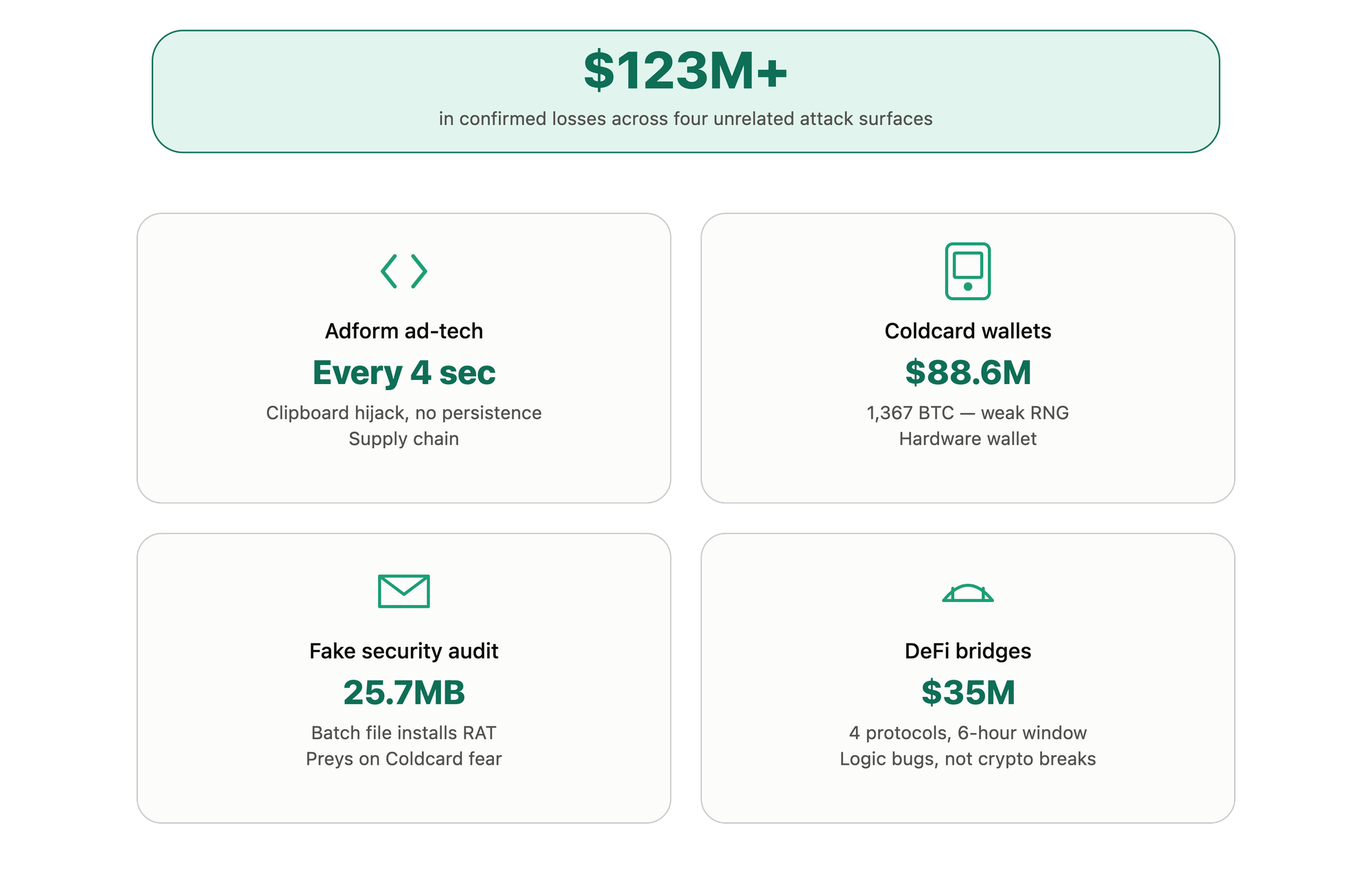
Four cryptocurrency-theft incidents surfacing within a two-week window share a detail worth pausing on before anything else: not one of them involved breaking cryptography. An advertising script got quietly rewritten. A hardware wallet's random number generator turned out not to be random enough. A handful of DeFi protocols handed out administrative powers they should never have granted. And in the strangest turn, the panic from one of those thefts became raw material for an entirely separate attack aimed at the same victims a second time. Together, these four cases show cryptocurrency theft spreading horizontally across the entire stack that holds digital assets — the ad-tech supply chain most users never think about, the "cold" hardware wallets marketed as offline and therefore safe, the smart contracts that run decentralized finance, and even the emotional aftermath of a real theft, reused as a lure.
The supply-chain case shows how little an attacker actually needs to touch to reach an enormous number of victims. Threat actors modified 'trackpoint-async.js,' a JavaScript tracking file served from Adform's own s2.adform.net infrastructure and embedded across every website using the ad-tech firm's platform, turning it into a browser-side tool that silently rewrites cryptocurrency wallet addresses on any page where the compromised script was running. Because Adform's tracking code can be deployed across an entire website, specific sections, or even a single page, and because any site using Adform's service inherits whatever that shared script does, the attackers gained a path into every downstream website's visitors without needing to compromise those websites individually — the compromise of one shared resource became the compromise of everyone who depended on it, as security researcher Kevin Beaumont put it: "if you visit example.com and they use Adform, example.com will compromise your device." Beaumont, who discovered the campaign, described its persistence bluntly: "Even if you notice the address is wrong and recopy the wallet, it keeps replacing it." The malicious code checked for clipboard copy events every four seconds and separately rewrote values typed directly into text fields, restoring the cursor position afterward so the substitution wouldn't visibly disrupt typing, with its replacement logic hidden behind a simple six-byte XOR obfuscation. Adform says the primary payload was built for exactly this narrow purpose — it created no persistence and only functioned while an affected page stayed open — but Beaumont separately found other malicious scripts hosted on Adform's infrastructure that were already answering the question Adform itself had left open: those scripts were confirmed sending visitors' IP addresses, referring website, and URL path to an attacker-controlled server, meaning the campaign wasn't limited to wallet-address substitution alone. Beaumont traced the malicious activity back to an Archive.org snapshot from July 26, indicating it had been running for roughly a week before detection.
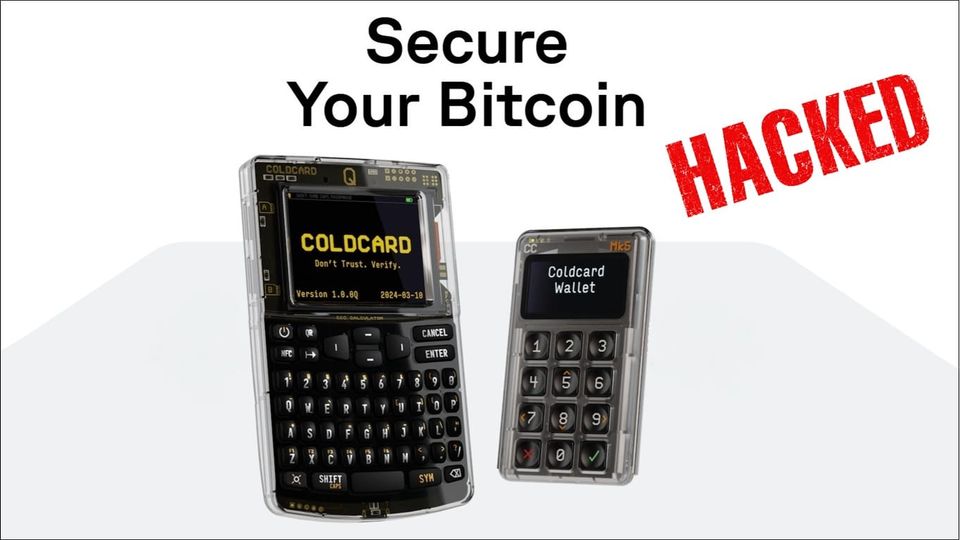
The hardware-wallet case is the most counterintuitive of the four, because it defeats a device whose entire selling point is staying disconnected from the internet. Galaxy Research linked a critical firmware flaw in Coinkite's Coldcard, a Bitcoin-only hardware wallet, to a theft that began at roughly $70.2 million across 1,196 wallets and was later revised upward to approximately $88.6 million — 1,367.05 Bitcoin — across 4,585 addresses. The underlying flaw traces back to a production configuration error introduced in March 2021: affected firmware generated wallet recovery seeds using MicroPython's Yasmarang software-based pseudorandom number generator instead of the device's dedicated hardware random number generator, and did so without collecting fresh entropy, relying instead on device identifiers and timer values that an attacker with knowledge of a device's unique ID and internal state could potentially reproduce. Because the weakness lives in how a seed was originally generated rather than in any ongoing network exposure, attackers never needed to touch a victim's actual device — they could generate candidate seeds offline, derive the corresponding wallet addresses, and check those addresses against Bitcoin's public blockchain until they found ones holding real funds, at which point the private keys, and the coins behind them, were effectively already theirs. Galaxy Research's on-chain analysis found the stolen funds moved in batches across six separate Bitcoin blocks rather than in one transaction, with three of those blocks showing no related activity at all — a pattern the firm reads as deliberate grouping by a single coordinated operator rather than opportunistic, scattered theft, though researchers caution that on-chain patterns alone can't conclusively prove theft rather than an authorized sweep. Coinkite shipped a firmware fix on July 31, one day after the theft was identified, but stressed that patching alone does nothing for wallets whose seeds were already generated under the flawed firmware — those seeds carry the same reduced entropy (an estimated 40 fewer bits for Mk3 devices, roughly 72 fewer bits for Mk4, Mk5, and Q devices, compared to a standard 128-bit BIP-39 seed) regardless of what firmware version is running today, meaning affected users have to generate entirely new seeds on patched firmware and migrate their funds rather than simply updating and continuing to use their existing wallet. This is also not an isolated category of failure: weeks earlier, a separate weak-randomness flaw dubbed "Ill Bloom" had already been tied to more than $5 million in losses spread across Bitcoin, Ethereum, Tron, Rootstock, and Polygon, underscoring that cryptographic entropy — not network exposure — is emerging as its own distinct point of failure for hardware wallets built to be otherwise unreachable.
What happened next turns this into something more unsettling than a single incident: criminals treated the theft itself, and the fear it generated, as a fresh attack surface. Proofpoint identified a phishing campaign launched in the immediate aftermath, sending emails from a spoofed compliance@coldcardteamnews.com address that impersonated Coinkite and claimed a mandatory hardware security audit was underway in response to "recent findings," directing recipients to a lookalike site to download an audit tool before an August 10 deadline — explicitly reassuring victims the process was air-gapped and would never request their recovery seed, the exact promise a nervous Coldcard owner most wants to hear. The fake site included a live chat feature that Proofpoint believes was staffed by real people rather than a bot, coaching hesitant victims through the installation process in real time; when one user reported seeing an unexpected administrator prompt, the human operator on the other end simply told them to click "Yes." The downloaded file ran a diagnostic-looking check that was actually testing for administrator privileges, then quietly installed a legitimate, signed DocuSign printer driver as a decoy alongside the real payload: a ConnectWise ScreenConnect installer that connected back to attacker-controlled infrastructure, handing whoever was behind the campaign live remote access to the victim's machine — access Proofpoint warns could be used to steal further cryptocurrency, exfiltrate data, or deploy ransomware. The entire campaign only works because a real theft had just happened; the attackers didn't need to invent a pretext, they simply had to arrive faster than Coinkite's own actual communications.
The fourth case shows the same "no cryptography broken" pattern playing out across decentralized finance in a single alarming afternoon. Within a six-hour window on July 23, four separate protocols lost a combined total of more than $35 million, and every incident traced back to either a logic flaw — code executing exactly as written, in a way its rules simply shouldn't have permitted — or an administrative key that granted an attacker control it should never have held. The worst hit was Verus's Ethereum bridge, where researchers at Blockaid caught an attacker exploiting a logic flaw to trigger unbacked payouts, draining roughly $7.54 million in ether, tokenized bitcoin, and stablecoins. What makes Verus's case land differently is that this was a repeat offense on the identical bridge contract and entry path: the same vulnerability had already been exploited in May for $11.5 million, after which the attacker voluntarily returned most of the funds in exchange for a bounty, Verus redeposited the recovered money, and the same path was drained again within two weeks — meaning this month's loss is at least the third time the identical door was used. Verus's total value locked tells the cumulative story better than any single incident: from close to $100 million at the start of 2025 down to roughly $9 million now, a decline punctuated by repeated breaches of a flaw the protocol evidently never fully closed. B² Network, a Bitcoin scaling protocol, lost a separate $3.86 million after an attacker obtained unauthorized upgrade powers over its token staking contract during Asian trading hours and converted the proceeds to ether and stablecoins before moving them off-chain, prompting the protocol to pause staking and pledge full compensation to affected users. Two further protocols, AFX and Balance, reported losses within the same rolling 24-hour period, bringing the total number of exploited platforms to four.
None of these four incidents required an attacker to defeat the mathematics underpinning cryptocurrency itself — every one of them found a boundary specific to its own layer of the stack and walked through it instead. Adform's attackers exploited the trust every downstream website places in a shared third-party script. Coldcard's attackers exploited a manufacturing-level assumption about where randomness comes from, in a device whose entire premise is that nothing about it can be reached remotely. The DeFi protocols' attackers exploited administrative and upgrade permissions that were, by design, more powerful than the safeguards protecting them. And the phishing campaign that followed the Coldcard theft exploited the simplest boundary of all: the reasonable trust a frightened victim places in what looks like an official response to a crisis that just happened to them. Diversification, in this context, doesn't mean criminals are inventing fundamentally new capabilities for each domain — it means the same underlying instinct, find the trust boundary nobody is actually testing, is now being applied wherever cryptocurrency value concentrates, regardless of whether that value sits behind an ad network, a firmware chip, a smart contract's owner key, or an inbox.