The Trust Multiplier: When One Vendor's Compromise Becomes Everyone's- 314

August 15, 2026
Three supply-chain compromises surfacing in the same stretch of reporting share nothing in terms of victim, geography, or motive, and that is exactly what makes them worth reading together. An AI infrastructure library got poisoned by a tool three layers removed from it. Hundreds of npm packages, many with names an AI coding assistant might plausibly suggest, quietly delivered malware to any developer who installed them. And a Russian enterprise video-conferencing platform got compromised at the server level specifically so that every client machine connecting to it, including from organizations that never chose to trust the compromised server in the first place, would receive a backdoored update. None of these attacks needed to breach their ultimate targets directly. Each one needed only to compromise a single point that a much larger population had already agreed to trust, and let that trust do the rest of the work.
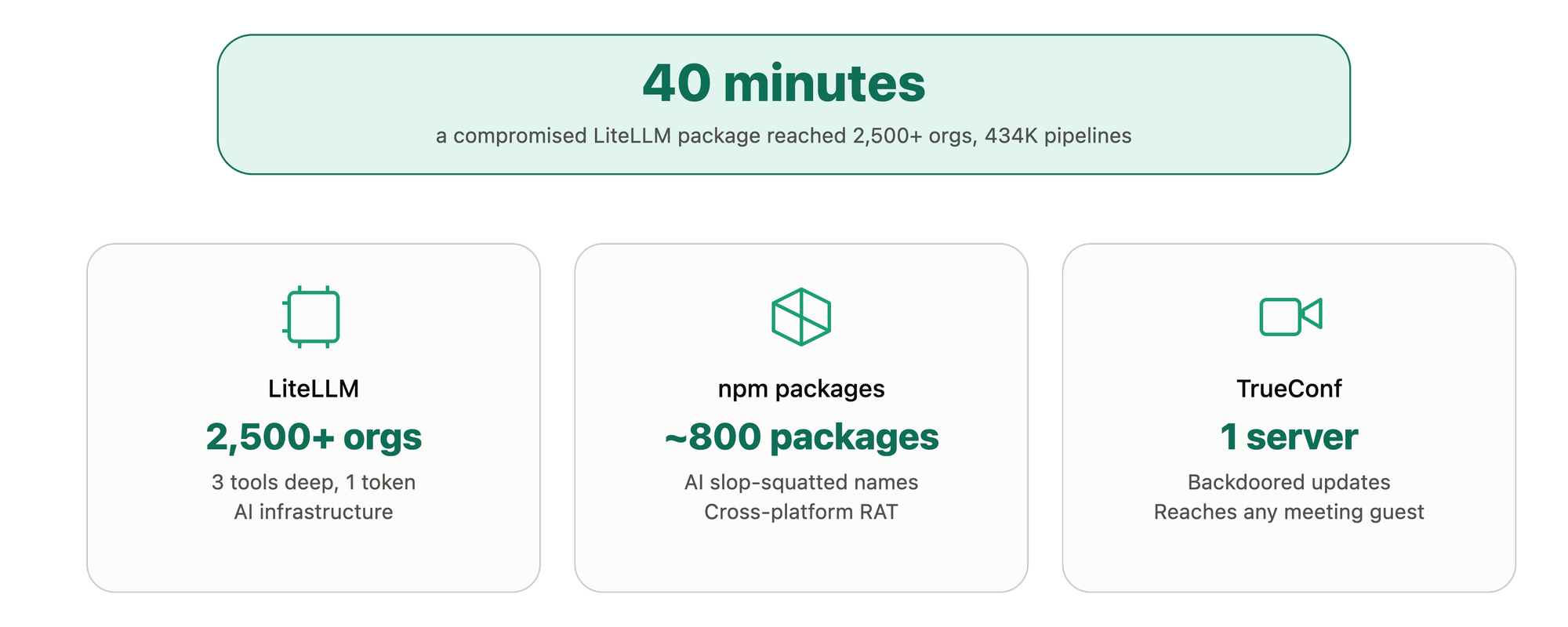
The clearest illustration of how fast this kind of compromise can spread comes from LiteLLM, an open-source Python library and proxy server that sits at the center of many organizations' AI infrastructure. CloudSEK's investigation found that LiteLLM was never targeted directly at all — it was compromised because its own continuous-integration pipeline automatically installed a poisoned version of a completely different tool, Aqua Security's Trivy vulnerability scanner, which had itself been compromised by a threat actor CloudSEK tracks as TeamPCP. That single unrevoked token propagated through three separate tools — Trivy, then LiteLLM's build system, then the LiteLLM release itself — before two compromised versions of LiteLLM were pushed live to PyPI, the public Python package registry. CloudSEK's own framing of the mechanics is precise: "Trivy, then the [LiteLLM] build system, then the LiteLLM release: one unrevoked token, three tools deep. That chain is what turns a single credential leak into ecosystem-wide exposure." The compromised packages were live on PyPI for only 40 minutes before being pulled, but that window was long enough for automated systems — scheduled jobs, dependency resolvers, ephemeral build runners, developer laptops, and cached container layers — to copy the malicious artifact far faster than any human could have intervened, since the malicious code executed automatically on every Python invocation with no explicit import required. CloudSEK's reconstructed exposure estimate puts the damage at more than 2,500 organizations and 434,000 CI/CD pipelines, including firms like Nvidia, AWS, Samsung, Salesforce, Cisco, Siemens, and the London Stock Exchange Group — though CloudSEK is careful to note that these figures describe reconstructed exposure, not confirmed compromise, and that each organization's actual exposure needs independent verification rather than being read off a list. What makes LiteLLM specifically worth attention isn't just the blast radius but where it sat: CloudSEK argues that AI infrastructure has become "high-value junctions between data, identity, compute, and autonomous action," and that this incident wasn't a software supply-chain breach that happened to touch an AI product, but a demonstration that compromising an AI control point exposes everything connected to it — a warning that future attacks are likely to target the AI layer precisely because of how much it now touches.
The second case shows the same trust-based multiplication working in the opposite direction — not one company's build pipeline reaching thousands of downstream users, but an attacker deliberately manufacturing hundreds of individually plausible entry points at once. Researchers identified nearly 800 malicious packages on the npm registry, a campaign OpenSourceMalware's Paul McCarty describes as a shift from traditional typosquatting — imitating one or two popular library names — to what he calls high-volume "AI slop-squatting": generating an enormous number of plausible-sounding package names, some of which a developer might select by mistake through typos, automated suggestions, or an AI coding assistant's own recommendation, rather than relying on any single name being convincing enough to fool someone deliberately. Once installed, the packages deploy a downloader called WEL1DROPPER that identifies the victim's operating system and processor architecture before retrieving the matching payload, and — in a detail that inverts the usual defensive advice — the packages instruct developers to load the malicious code through JavaScript's ordinary require() function rather than through the preinstall or postinstall scripts most npm supply-chain attacks rely on, making the behavior less conspicuous during routine installation review. Sonatype, which tracks the campaign as Flooding Dropper, found the Windows variant actively interferes with Event Tracing for Windows and the Antimalware Scan Interface, checks for signs it's running inside a sandbox, and establishes persistence through registry run keys, while the Linux payload deploys the open-source Sliver command-and-control framework and the macOS version searches for debugging tools before persisting via a LaunchAgent — the campaign spans all three major developer operating systems by design rather than accident. Researchers also found a file named telemetry.js bundled among the packages that performs the identical downloader function while posing as ordinary analytics code, adding a layer of camouflage aimed specifically at developers who might glance at file names during a review. The campaign is suspected to be an evolution of the previously documented Moika operation, and notably, it isn't tied to any CVE or listed vulnerability at all — the exposure here isn't a flaw in npm's software, but the basic reality that a compromised development machine or CI/CD system routinely holds cloud credentials, SSH keys, registry publishing tokens, and source code that extend an attacker's reach well beyond the single workstation that was actually infected.
The third case shows the same dynamic playing out at the level of an entire enterprise communications platform, where the compromise reaches organizations that never had any direct relationship with the attacker's actual point of entry. The Head Mare hacktivist group, according to Kaspersky, has been exploiting unpatched TrueConf video-conferencing servers — a widely used on-premise alternative to Zoom and Microsoft Teams across Russian enterprise and government sectors — connecting to an unauthenticated port left open by default and chaining two vulnerabilities to escape TrueConf's isolated execution environment and run commands directly on the underlying operating system with full SYSTEM privileges. From there, the attackers replaced a core server file with a web shell, giving themselves persistent access to harvest sensitive data, and used that access to swap out the legitimate TrueConf client installer hosted on the compromised server with a trojanized, unsigned version carrying the PhantomCore backdoor — meaning any employee whose organization runs that server receives a backdoored "update" the next time they connect. Kaspersky's warning captures exactly the trust-multiplier problem this piece is built around: "Even if your organization does not use the TrueConf server, employees of the organization can connect to compromised counterparty TrueConf servers to participate in online meetings and download infected installation packages" — the compromise reaches past the boundary of the breached organization entirely, into any partner or client who simply joins a meeting hosted there. Head Mare separately deploys a second backdoor, PhantomGraph, built from two DLL files that receive commands through a Microsoft OneDrive account and have been observed dumping credentials directly from the LSASS process, alongside routine reconnaissance and a reverse SSH tunnel. Kaspersky says it is tracking multiple active Head Mare campaigns against Russian organizations across instrumentation, electronics, transportation, energy, IT, and software development, using phishing, exposed web servers, and contractor access as parallel entry points alongside the TrueConf compromise — and this is not TrueConf's first brush with this exact failure mode, either: a separate zero-day, tracked as CVE-2026-3502 and tentatively attributed to Chinese threat actors behind the Havoc implant, was already being used months earlier in a campaign called Operation True Chaos to distribute trojanized TrueConf client updates through the identical mechanism.
What ties LiteLLM, the npm campaign, and TrueConf together is not a shared attacker or a shared victim profile, but a shared arithmetic: in every case, compromising one trusted point bought the attacker access to a population far larger than anything a direct attack on individual victims could have achieved in the same amount of effort. LiteLLM's attackers didn't need to breach Nvidia, AWS, or the London Stock Exchange Group directly — they needed forty minutes on a package registry and a chain of unrevoked trust reaching back through three separate tools. The npm campaign's operators didn't need to convincingly impersonate any single popular library — they needed enough plausible names, at large enough volume, that the ordinary process of choosing a dependency would eventually choose one of theirs. And Head Mare didn't need to breach every organization running TrueConf — they needed one exposed port on one unpatched server, because every subsequent client connection, including from organizations with no direct relationship to the compromised server at all, arrived already carrying the trust that made the rest of the attack unnecessary.