Identity at Risk: The ANTS Breach and France's Digital Public Service Exposure- 200

June 16, 2026
A 15-year-old selling stolen data on cybercrime forums under the alias "breach3d" managed to extract personal records on what may be a third of France's population from the agency that manages the country's passports, national identity cards, and residence permits. He was arrested seventeen days after the breach was detected. The speed of the response is reassuring. The fact that the door was open at all is not.
The breach of France's National Agency for Secure Documents — ANTS, the agency that processes applications for passports, national identity cards, residence permits, and driver's licenses — was detected on April 13, publicly acknowledged on April 20, and had led to the detention of a suspect ten days later. By April 30, the Paris Prosecutor's Office had opened a formal judicial investigation and was seeking charges against a 15-year-old, using the online alias "breach3d," accused of stealing between 12 million and 18 million lines of personal data and offering them for sale on cybercrime forums. If the volume holds and each record pertains to a distinct individual, the breach potentially affected roughly a third of France's population.
What makes the ANTS case analytically significant is not the scale alone but the combination of what was breached, by whom, and as part of what pattern. ANTS is not simply another government database. It is the digital interface between French citizens and the state's identity infrastructure — the portal through which people submit applications for the foundational documents that underpin their legal identity, their ability to travel, and their residency status. The data exposed — login credentials, full names, email addresses, dates of birth, unique account identifiers, postal addresses, and phone numbers — is not the most sensitive information ANTS holds. The ministry was explicit that documents uploaded during administrative procedures, such as scans or photographs submitted as part of applications, were not compromised. But the account metadata around identity document applications is inherently sensitive material: it is precisely the dataset from which convincing phishing campaigns, impersonation attempts, and identity fraud operations are constructed. Names, dates of birth, and postal addresses in combination with the knowledge that an individual has an active ANTS account — meaning they have recently applied for a passport or ID card — create targeted social engineering opportunities at industrial scale.
The perpetrator profile complicates any straightforward reading of the incident. This was not a state-sponsored APT, not a ransomware group with a ransom note and a leak site, not a sophisticated criminal organisation. The suspect is a minor whose online alias suggests a financially motivated data broker rather than an intelligence collector. France's juvenile justice system is oriented toward rehabilitation rather than punishment — the maximum sentences applicable to adults carry substantially reduced equivalents for minors — but the legal exposure is nonetheless real: up to seven years and €300,000 in fines for each of the two computer crime allegations. The speed of France's institutional response was notable: breach confirmed, public disclosure, arrest, and judicial proceedings all within seventeen days, which reflects an investigation process that either moved with unusual efficiency or had intelligence about the seller in advance of the public announcement.
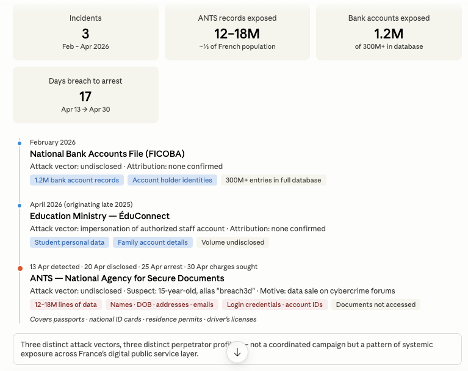
The ANTS breach cannot be read in isolation from the quarter in which it occurred. France's Education Ministry disclosed in the same window that a breach of its ÉduConnect student account platform — originating from the impersonation of an authorized staff account in late 2025 — had exposed student personal data. In February, attackers breached part of France's National Bank Accounts File, exposing information linked to approximately 1.2 million accounts. Three significant French public institution breaches in a single quarter, with different attack vectors and different apparent perpetrators, do not constitute a coordinated campaign. They describe something potentially more structurally concerning: a pattern of exposure across the digital public service layer that suggests systemic underinvestment in the security of platforms that aggregate large, high-value personal datasets, rather than any single failure of any single system.
The deeper question the ANTS case poses is one of proportionality between asset value and security investment. The data held by ANTS — identity document application metadata for an entire national population — is, in aggregate, among the most sensitive civilian datasets a state manages. It is the substrate from which identity fraud operates. Whether the breach reflects a specific vulnerability in the ANTS portal architecture, a failure of access controls, or something in the shared authentication infrastructure serving French government digital services is not yet public. What is clear is that the threshold for accessing and exfiltrating that data appears to have been low enough for a 15-year-old to clear it. That gap — between the sensitivity of what the system holds and the difficulty of extracting it — is the structural finding the investigation should eventually answer, and the one French digital service security policy will need to address beyond the resolution of this specific case.