An unclaimed breach at a critical drug-packaging supplier tests healthcare's newest fault line- 234

May 12, 2026
West Pharmaceutical Services, one of the world's largest suppliers of components for injectable medicine delivery, disclosed to the SEC this week that a hacker breached its network, stole data, and encrypted systems — disrupting shipping, receiving, and manufacturing operations globally at a company whose stoppers, seals, and auto-injector components sit in the supply chain behind how injectable drugs actually reach patients. No ransomware group has claimed responsibility, which in itself says something about how healthcare-adjacent manufacturing has become a target profile broad enough to attract state and criminal actors alike, often using indistinguishable techniques.
The company's own account, filed as an 8-K with the Securities and Exchange Commission, describes an intrusion detected on May 4 that led to both data theft and system encryption, with the company's proactive containment response itself contributing to the operational disruption that followed. West Pharmaceutical has since restored its core enterprise systems, and critical shipping, receiving, and manufacturing processes have resumed at some sites, though the company has not finalized a timeline for full restoration across its network. The response followed a familiar containment playbook: isolating affected on-premise infrastructure, restricting enterprise system access, and notifying law enforcement, while Palo Alto Networks' Unit 42 incident response team was brought in to lead the investigation. West Pharmaceutical says it has taken steps intended to mitigate the risk of the stolen data being disseminated, though it remains uncertain what information was actually exfiltrated or what the ultimate financial impact will be.
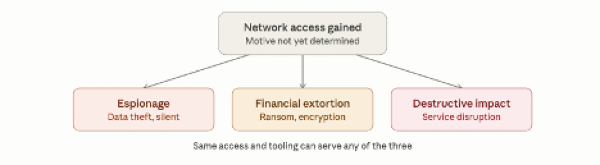
The absence of a claiming ransomware gang, more than a week after the SEC disclosure, is itself notable against the backdrop this incident sits within. West Pharmaceutical is not a peripheral player: with more than 10,000 employees across 50 global locations and over $3 billion in 2025 net sales, the company manufactures components for syringes, cartridges, auto-injectors, and wearable injector devices — the physical infrastructure that determines whether injectable medicine can be delivered safely at all. A sustained disruption at this scale of vendor concentration carries consequences that extend past West Pharmaceutical's own balance sheet and into the drug developers and healthcare systems that depend on its components reaching manufacturing lines on schedule.
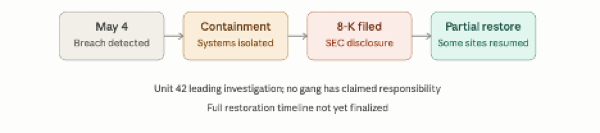
Errol Weiss, chief security officer at the healthcare information-sharing organization Health-ISAC, frames this incident as one data point within a broader and more troubling pattern: a sustained, elevated level of malicious activity targeting the healthcare sector from both nation-state actors and cybercriminals throughout 2026. What concerns him most is not any single motive but the interchangeability of technique — the same access and tooling used for espionage, financial extortion, or destructive impact are functionally indistinguishable until an attacker decides what to do with the foothold they've already established. In a sector where system interruption can translate directly into patient risk, that ambiguity is the real threat: an unclaimed breach at a component supplier isn't just an unresolved investigation, it's a live illustration of how thin the line has become between a ransomware payday and a disruption engineered to cause harm.