A single breach at Foxconn just exposed how concentrated the electronics supply chain really is- 233

June 28, 2026
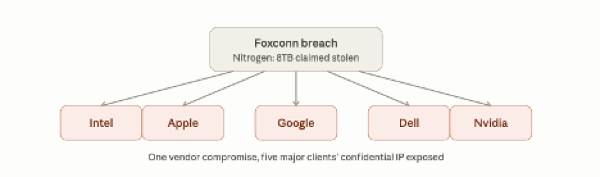
When the Nitrogen ransomware group listed Foxconn on its Tor leak site in March, it wasn't just claiming another manufacturing-sector victim — it was claiming access to roughly 8 terabytes of confidential documents, instructions, projects, and drawings belonging not to Foxconn alone, but to Intel, Apple, Google, Dell, Nvidia, and other major clients whose products the Taiwanese contract manufacturer builds. A single compromise at one vendor, in other words, potentially fans out into intellectual property exposure across the companies that define the entire consumer electronics industry.
Foxconn confirmed the attack affected several of its North American factories, with a company spokesperson stating that its cybersecurity team activated response measures to maintain continuity of production and delivery, and that affected factories were resuming normal operations. Nitrogen backed its claim with published photographs of stolen documents as proof of access, though the company has not detailed the precise scope of what was actually exfiltrated versus what Nitrogen has publicly showcased. The structural exposure here is what distinguishes this from an ordinary ransomware disclosure: Foxconn is the world's largest contract electronics manufacturer, building the physical products behind Apple, Sony, and Microsoft's device lines across a global factory footprint spanning smartphones, computers, and gaming consoles. Any breach at that scale of vendor concentration carries risk that extends well past Foxconn's own balance sheet, into the design files and supply relationships of the companies that depend on it.
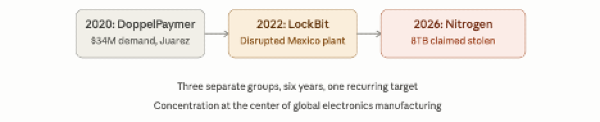
This is not Foxconn's first experience with this exact category of threat, and the pattern across incidents is instructive. In June 2022, the LockBit ransomware gang claimed responsibility for an attack that disrupted Foxconn's production in Mexico. Two years earlier, in 2020, the DoppelPaymer group hit the company's plant in Ciudad Juárez and demanded a $34 million ransom — at the time, one of the largest publicly known ransom demands against a manufacturing target. Read together with the current Nitrogen claim, three separate ransomware operations across roughly six years have each independently identified Foxconn as a target rich enough, and structurally central enough, to justify the effort. That repetition suggests the company's exposure isn't incidental but a predictable consequence of sitting at the center of global electronics manufacturing — a single point of concentration that ransomware operators have learned to return to precisely because compromising it yields leverage over an entire industry's client roster, not just one company's operations.