What Medtronic's Own Notice Leaves Unsaid: A Breach, an Extortion Claim, and a Company That Won't Connect the Two- 276

July 5, 2026
Medtronic, the world's largest medical device manufacturer, has begun formally notifying 3.83 million people that their personal and health information may have been stolen in an April cyberattack — but the company's own account of what happened is notable as much for what it omits as for what it discloses, most conspicuously any mention of the criminal group that claims to have carried it out.
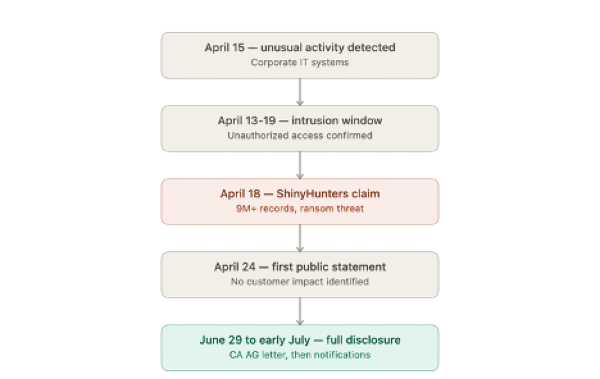
The timeline, reconstructed across Medtronic's public statements and the notification letter itself, runs as follows. Medtronic detected unusual activity on its corporate IT systems on April 15, and a subsequent investigation determined that an unauthorized party had access to those systems for a six-day window, from April 13 to April 19. On April 18, in the middle of that window, the extortion group ShinyHunters added Medtronic to its dark web leak site, claiming to have stolen more than nine million records of personal data and internal files, and threatening publication unless a ransom was paid by April 21. Medtronic issued its first public statement on April 24, at that point saying it had identified no impact to customers. The ShinyHunters listing disappeared from the leak site later in April without any data being published — consistent with the group's established pattern of pulling entries once a payment arrangement is reached, though Medtronic has not confirmed whether any payment was made. It took until early July, roughly two and a half months after the intrusion, for the company to begin sending individual notification letters, and the fuller picture of who was affected only became public on June 29, when the California Attorney General's office released a copy of that letter.
The letter itself, now public, states plainly that Medtronic collects data on patients with its medical devices "in order to provide important product-related updates and to meet our legal obligations" — a reminder that the exposure here extends beyond a conventional corporate personnel breach into a manufacturer's clinical record-keeping on the people who depend on its devices. The categories of data involved were consistent across every account: full names, contact information, dates of birth, Social Security numbers, and health-related information. Medtronic has repeated in each disclosure that it has no evidence the stolen data was ever posted publicly or exposed online, and that patient safety and device operation were never affected — the company has been explicit that its corporate IT environment is architecturally segregated from the networks supporting its products and manufacturing, and that hospital customer networks are managed independently by the hospitals themselves rather than by Medtronic.
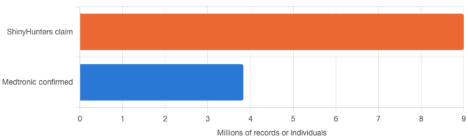
What the company's own notification does not do is name ShinyHunters, describe the incident as an extortion attempt, or otherwise acknowledge the ransom threat that gave the story its urgency in April. That attribution exists only in security reporting and in ShinyHunters' own dark web claims, not in anything Medtronic has put its name to. Left similarly unaddressed is the sizable gap between the attacker's claim of more than nine million stolen records and the 3.83 million individuals Medtronic has now confirmed it is notifying — a gap that may simply reflect the difference between raw record counts and unique affected people, but one the company has not explained. Nor has Medtronic disclosed how the attackers gained access in the first place, or why formal notification took as long as it did. What the company has offered instead is remediation: twenty-four months of complimentary credit monitoring, dark web monitoring, and identity restoration services administered through a third-party provider, alongside statements that it has engaged law enforcement, notified relevant regulators, and hardened its systems since the incident.
The breach also arrives as one data point in a wider pattern of attacks against the medical device sector, which now faces pressure from two structurally different directions at once. Where ShinyHunters' interest in Medtronic appears to be conventional data theft for extortion, the medical device maker Stryker disclosed in March that its systems had been wiped in an attack federal prosecutors attributed to Iran-linked hackers — an intrusion with a materially different character and consequence, disrupting emergency medical services and hospital operations in Maryland badly enough that some hospitals temporarily severed their connections to Stryker's systems as a precaution. Set against each other, the two incidents illustrate that the sector's exposure is no longer a single threat model: criminal extortion groups are treating medical device makers as data-rich, reputationally sensitive targets willing to pay to avoid a leak, while state-linked actors are separately demonstrating a willingness to inflict direct operational disruption on the clinical infrastructure those same companies supply.