Washington Recasts Pig-Butchering as a National-Security Problem: Inside the $43 Million Network That Fed China-Bound Laundering Pipelines- 271

July 21, 2026
The indictment of two Brooklyn and Queens residents accused of laundering more than $43 million in cyber-enabled investment fraud proceeds would, in an earlier enforcement era, have registered as a conventional financial-crime prosecution. That it instead arrives wrapped in the language of homeland security — invoked explicitly under a Homeland Security Task Force created by executive order to dismantle transnational criminal organizations — signals a deliberate reclassification underway in Washington: pig-butchering schemes and the China-bound laundering infrastructure that sustains them are no longer being treated as garden-variety fraud, but as a node in the broader architecture of transnational organized crime that the U.S. security apparatus is now mobilized to dismantle.
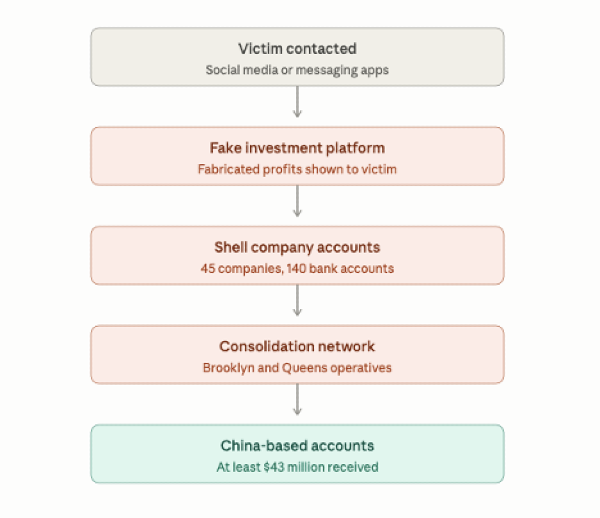
The mechanics of the case are, by now, a familiar template. Prosecutors allege that Zhuoying Chen and Haojie Zhang oversaw a network of more than a dozen operatives who opened 140 bank accounts under some 45 shell companies, absorbing funds extracted from victims cultivated over weeks through social-media and messaging-app relationships before being steered toward fabricated investment platforms. The underlying fraud, methodically documented across the source reporting, functions less like opportunistic deception than a scripted commercial operation — complete with customer-relationship-management tooling, multilingual staff, and performance targets, a professionalization that industry researchers say increasingly defines the sector rather than distinguishes it. What made the scheme viable at scale, however, was not the fraud itself but the laundering layer behind it: a purpose-built network of shell entities engineered specifically to receive, blend, and relay stolen capital to co-conspirators in China before victims or investigators could trace it.
The scheme's durability rested on two distinct engineering processes operating in sequence. The first was psychological: perpetrators-initiated contact through unsolicited messages on social media, dating platforms, or encrypted apps, then deliberately withheld any financial ask for days or weeks, using that time to simulate a genuine relationship before introducing a supposedly lucrative — often crypto-denominated — investment opportunity. Victims were then moved onto professional-looking trading platforms displaying fabricated running profits, a design engineered specifically to encourage victims to escalate their contributions before ever attempting a withdrawal; by the time a withdrawal was attempted and blocked, both the platform and its operators had vanished. The second process was financial, and this is where Chen and Zhang's alleged role begins: victim deposits arriving as many discrete transfers were absorbed across 140 accounts held under 45 shell companies, a structure whose only purpose was to break the audit trail between individual victims and the aggregate proceeds. Only after this layering — dispersing funds across dozens of nominally unconnected entities — were the proceeds consolidated and moved as bulk transfers to co-conspirators in China, the final step that converted traceable victim payments into untraceable offshore capital. It is this placement-layering-integration cycle, standard to money laundering but executed here at unusual structural scale, that explains why recovery for victims becomes practically impossible once funds clear the shell layer.
It is the prosecutorial framing, not the fraud pattern, that marks the more consequential shift. The Justice Department's own announcement situates the case within the Homeland Security Task Force established under Executive Order 14159 — an initiative built around dismantling cartels, transnational criminal organizations, and trafficking networks, with explicit reference to child-trafficking enforcement and the removal of "criminal aliens."
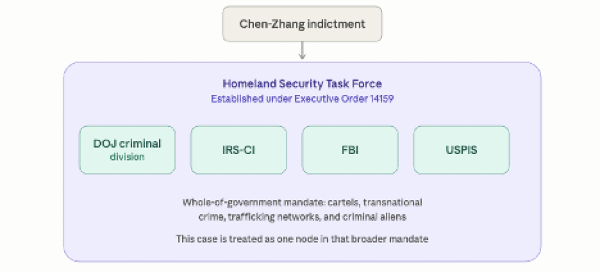
Folding a China-linked money-laundering ring for investment fraud into that same institutional apparatus reflects a widening of what counts as a homeland-security threat: financial infrastructure that facilitates the outflow of American victims' capital to foreign jurisdictions is now being treated with the same institutional urgency as human trafficking and cartel violence. That framing carries diplomatic weight as well as prosecutorial utility, implicitly casting China-based financial networks as a facilitating environment for laundering flows that U.S. authorities have limited practical ability to interdict once funds cross the border.
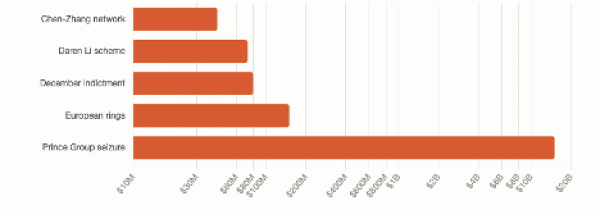
This case did not emerge in isolation. It lands amid a broader enforcement wave — the Justice Department's seizure of $15 billion tied to the leader of the Prince Group, the establishment of a dedicated Scam Center Strike Force, a string of related indictments involving tens of millions in additional losses, and parallel takedowns by European authorities disrupting rings responsible for over €150 million in losses. Read together, these actions suggest Washington is no longer prosecuting pig-butchering as a series of discrete criminal episodes but is instead attempting to map and dismantle the transnational financial plumbing — the shell companies, mule networks, and cross-border settlement channels — that has allowed cyber-enabled investment fraud to metastasize into one of the most lucrative categories of financial crime, accounting for roughly half of all reported scam losses in the United States last year. The Chen-Zhang case is a single data point in that campaign, but its institutional framing reveals how far the definition of "national security threat" has stretched to accommodate the financialized, cross-border nature of modern cybercrime.