Two years of silence: what South Staffordshire Water's fine reveals about detection failure- 219
May 12, 2026
A British water utility serving 1.6 million people harbored the Cl0p ransomware group inside its network for nearly two years before an IT performance slowdown — not a security alert — tipped off investigators. The £963,900 fine the UK's Information Commissioner's Office levied against South Staffordshire Water this week is less a story about a sophisticated attacker than about how far basic security hygiene can erode before anyone notices, and what that erosion means for a sector now facing a record run of cyberattacks.
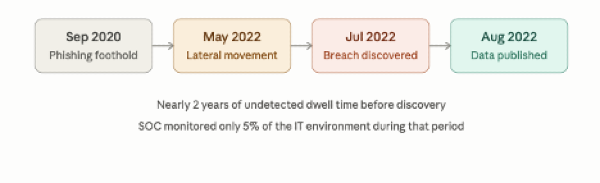
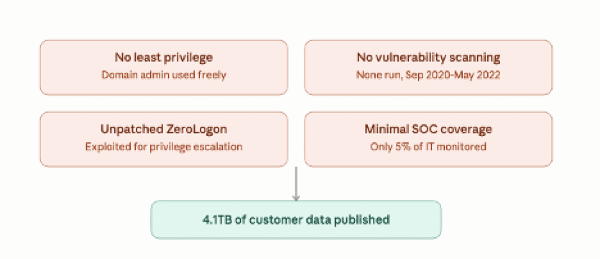
The intrusion timeline reads as a case study in cascading neglect rather than a single catastrophic failure. An employee opened a malicious email attachment in September 2020, giving the attacker an initial foothold. The threat actor then sat dormant for roughly twenty months before beginning lateral movement in May 2022, exploiting a domain administrator account — the highest level of access in the network — to move freely across systems. The ICO's investigation found that as of December 2021, over a year into the intrusion, an outsourced security operations center was monitoring just 5 percent of the company's IT environment, with endpoint telemetry never integrated into its monitoring platform. When asked to provide records of vulnerability scans conducted between September 2020 and May 2022, the company confirmed none existed for either internal or external systems. Two domain controllers remained unpatched against ZeroLogon, a critical privilege-escalation vulnerability published in August 2020 — the very flaw the attacker ultimately exploited. Some devices were still running Windows Server 2003, whose extended support had ended seven years earlier. The company only discovered the breach in July 2022 through IT performance issues, and confirmed it two weeks later upon finding a ransom note the attacker had unsuccessfully tried to distribute internally. By then, roughly 4.1 terabytes of data — including bank details, National Insurance numbers, and information from which disabilities could be inferred for customers on the company's Priority Services Register — had been published on the dark web.
The breach's public emergence in August 2022 carried its own layer of confusion: Cl0p initially misattributed its claims to a different supplier, Thames Water, and asserted it could alter the chemical composition of the water supply — a claim South Staffordshire disputed and one the ICO's penalty notice does not substantiate. No compromise of operational or water treatment systems is referenced in the regulator's findings. That distinction matters for how this incident should be read: this was an IT-side governance failure, not an OT-side sabotage event, and the ICO's characterization of the infringements as medium severity — reduced further by the company's cooperation, early admission of liability, and a 40 percent settlement discount — reflects that scope.
The fine lands amid a broader deterioration in the sector's threat exposure. Five cyber incidents were reported to the UK's Drinking Water Inspectorate between January 2024 and October 2025, a record for any two-year period, though current NIS Regulations only mandate reporting when an incident actually disrupts water supply — a threshold South Staffordshire's breach never met. The UK's forthcoming Cyber Security and Resilience Bill aims to widen that reporting requirement, but the broader pattern across water utilities remains uneven: while IT-side ransomware against water companies is now common — including Spain's Aigües de Mataró — attacks that reach operational technology and actually disrupt service remain rare. The exceptions are instructive rather than reassuring: a 2023 pro-Iran hacktivist campaign against Unitronics PLCs left an Irish coastal community without water for days, and Canadian authorities separately reported hacktivists altering water pressure at a local utility. Regulatory tightening in the U.S., meanwhile, stalled when water industry groups partnered with lawmakers to halt federal security initiatives despite rising attack volume — a reminder that South Staffordshire's failure to scan, patch, or monitor its own network for two years was not an aberration so much as a symptom of how unevenly critical infrastructure security is still enforced.