The Maintenance Excuse: Zbtlink, the National Intelligence Law, and the Case Against Trusting Chinese Router Firmware- 295
August 8, 2026
On August 6, Chinese router maker Zbtlink told a reporter that a hidden remote-command implant researchers had just found on its routers was "solely intended for after-sales maintenance" — then, that same week, quietly pulled every affected firmware image from its download page without explanation. The threat-intelligence firm VulnCheck had found something its own chief technology officer, Jacob Baines, called an implant rather than a bug: disguised processes that dial out to a hardcoded server and wait for orders. The case matters less for its own week of headlines than for where it sits inside a larger, already-answered question: whether it is possible to trust network hardware built by a company that operates, by Chinese law, under a standing obligation to cooperate with state intelligence work if asked.
VulnCheck found the implant — named ENDLESSDOORS — disguised as ordinary "kworker" kernel threads on a Zbtlink AX3000, running as root with no handshake, no key exchange, and no verification of who controls the other end. Whatever the command server sends is executed as root; one reserved command opens a live interactive shell. VulnCheck proved the risk was real by impersonating the server and getting root access back in under two seconds. Across the 20-plus affected models, the entire fleet phones home to just four addresses, hosted on Alibaba Cloud, Vultr, and a Chinese cloud provider.
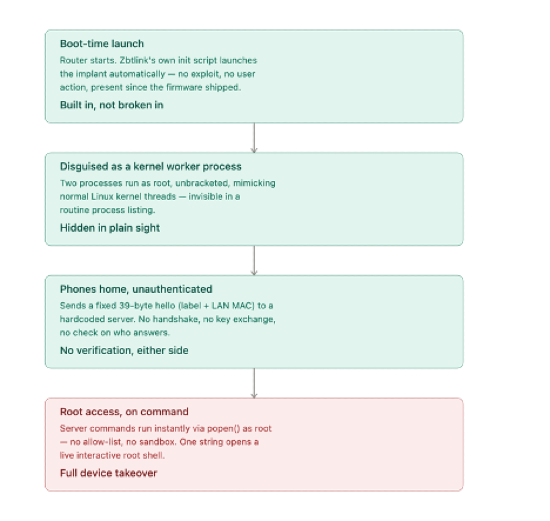
VulnCheck skipped private disclosure because the implant was built into Zbtlink's own boot script across two dozen models — not a bug that slipped through review. The vendor's explanation collided with its own actions: the Wayback Machine's July 31 snapshot still showed a full firmware catalog; days later the same page announced a security-driven download pause. Sold under four brand names — Zbtlink, ZBT, ZBTWiFi, Wiflyer — on Amazon, Alibaba, and Shopify, with no clean firmware available, researchers are telling owners to replace affected units outright.
This is not the first time a Chinese hardware vendor has offered a "leftover diagnostic feature" defense for an unauthenticated backdoor. Vodafone found similar access in Huawei equipment in 2011, an episode that fed a decade of US restrictions culminating in FCC equipment bans. That pattern reached new scale this year: on March 23, 2026, the FCC added foreign-produced routers to its Covered List following scrutiny of TP-Link, whose routers Microsoft found embedded in attacks on US government and defense targets. The legal backdrop is explicit, not speculative — Article 7 of China's 2017 National Intelligence Law requires that "all organizations and citizens shall support, assist, and cooperate with national intelligence efforts." No evidence here proves state direction, but that law is why regulators no longer treat vendor negligence and state risk as separable questions for Chinese-made hardware.
Whether or not anyone in Beijing asked Zbtlink for anything, the shape of this episode — a root-level implant, shipped by design, defended with an excuse its own actions contradicted — is exactly the pattern the FCC's blanket ban and the Huawei precedent were built to route around. An unauthenticated backdoor on Chinese-made hardware is no longer being treated as a bug-tracker problem. It is being treated as a Chinese-hardware problem, full stop.