The Forecast That Confirmed Itself: Agentic AI and the Acceleration of Cybercrime- 192

June 21, 2026
In late 2025, cybersecurity analysts issued a warning that felt closer to speculative fiction than immediate reality: the imminent transition from human-managed "cybercrime-as-a-service" to a highly autonomous, AI-driven ecosystem termed "cybercrime-as-a-sidekick." This shift is no longer a distant threat—it is actively unfolding. This report examines how agentic artificial intelligence is fundamentally restructuring the criminal economy. By shifting from rigid, pre-programmed automation to flexible, self-coordinating AI agents capable of planning, executing, and adapting attacks with minimal human oversight, threat actors are drastically collapsing the timeline between vulnerability discovery and weaponization. Ultimately, this report serves as a wake-up call for modern defense paradigm shifts. By deconstructing the Three Laws of Cybercrime Adoption, we explore how criminal innovation proceeds incrementally until a nexus event tips the balance irreversibly. We will map out the structural implications of these AI-assisted workflows and outline how security teams must adapt to counter a threat landscape that moves at the speed of algorithmic iteration.
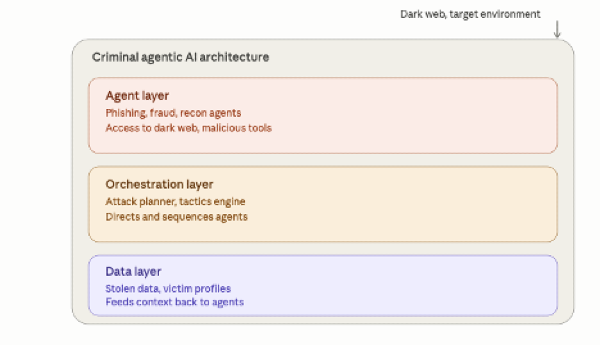
In September 2025, Trend Micro's Forward Looking Threat Research team published a forecast that read, at the time, as informed speculation: agentic artificial intelligence would not merely accelerate existing cybercrime but restructure the criminal economy itself, replacing a marketplace of human-operated services with autonomous agents capable of planning, executing, and adapting attacks with minimal supervision. The researchers framed the transition as a shift from "cybercrime-as-a-service" to "cybercrime-as-a-sidekick" — a modular, self-coordinating ecosystem governed by what they called the Three Laws of Cybercrime Adoption: criminals gravitate toward whatever offers an easier life, new techniques spread only once their return clearly exceeds existing alternatives, and criminal innovation proceeds incrementally until a nexus event — a rapid, ecosystem-wide surge in adoption — tips the balance irreversibly. Within six months of that forecast, three independent developments each confirmed a distinct pillar of the argument.
The first came from a controlled but revealing experiment. A security researcher pointed Claude Opus at a deliberately outdated build of Chrome bundled inside Discord — nine major versions behind upstream, running without a sandbox on its main window — and asked it to construct a complete V8 exploit chain. One week, 2.3 billion tokens, and $2,283 in API costs later, the model produced a working remote code execution chain. The researcher was careful to note the model's limitations: it lost context, guessed rather than verified, and required human intervention at nearly every stuck point. But the structural implication was clear. A single skilled operator, paired with a widely available model, can now turn a published security patch into a working exploit at a cost already below the payout of Google's v8CTF bug bounty program, and far below what the same capability would fetch on underground markets. Every patch, as the researcher put it, is now an exploit hint — and AI collapses the time between disclosure and weaponization.
The second confirmation came not from a test but from forensics. An exposed, misconfigured server belonging to a live criminal operation gave investigators a complete operational record. The Bissa scanner, as researchers labeled it, combined CVE-2025-55182 — the critical React2Shell remote code execution flaw — with an automated pipeline that scanned the internet at scale, triaged compromises by value, and routed real-time alerts to a Telegram channel monitored by a single operator. More than 900 confirmed compromises, credentials harvested across every tier of cloud infrastructure: AI provider keys for Anthropic, OpenAI, Google, and a dozen others; payment processor tokens; banking integration credentials; identity secrets. What distinguished the find from a routine exploitation case were the recovered operator transcripts showing direct, day-to-day use of Claude Code and a tool called OpenClaw as a working harness for reading the scanner's own codebase, debugging failures, and refining the pipeline — exactly the AI-assisted criminal workflow Trend Micro had described as an early-stage indicator. Readers following this publication's recent coverage of automated Chinese exploitation infrastructure built around a near-identically named orchestration tool may draw their own conclusions about the recurrence; nothing in the Bissa record establishes a link, but the coincidence of name and function across two independently surfaced campaigns is the kind of detail that rarely stays a coincidence for long.
The third confirmation arrived at industry scale. Google's Cloud Threat Intelligence team reported that vulnerability exploitation has overtaken stolen credentials and phishing as the dominant cloud entry method — a shift attributed substantially to AI tooling that now helps attackers parse technical disclosures and generate working exploits faster than manual reverse engineering allowed. Google also documented what it characterized as the first confirmed case of a threat actor using a zero-day believed to have been developed with AI assistance, intended for a mass exploitation event that proactive detection may have prevented. The trend, Google's researchers concluded, will continue expanding.
Trend Micro described the tipping point as a nexus event — the moment when all three adoption conditions align simultaneously and criminal uptake surges in a compressed window. The three confirmations above, arriving within a single threat reporting cycle, each validating a different layer of a forecast published only months earlier, suggest the event is no longer a prediction. It is underway.