Russia's silent reach into the world's mailboxes- 284

July 23, 2026
A newly documented Russian-linked cyberespionage campaign has spent the past year quietly draining the contents of webmail accounts across critical industries worldwide, using a flaw so effective that victims never have to click, open, or interact with anything at all — the mere act of receiving the email is enough to hand over their inbox. The campaign, tracked by Palo Alto Networks' Unit 42 as CL-STA-1114, overlaps with a threat actor already known to other security vendors as Void Blizzard and LAUNDRY BEAR — both names associated with Russian state-linked intelligence collection — reinforcing that this is not opportunistic crime but a deliberate, sustained state-espionage operation.
The campaign has been running since at least 2024, with the specific technique described here active since July 2025. It targets organizations that rely on Zimbra Collaboration Suite, a widely used webmail platform, by exploiting a specific software flaw catalogued as CVE-2025-66376. What makes this exploit unusual is that it requires zero clicks from the victim: the malicious email itself contains an invisible graphic element built to look like a harmless image file, which silently decodes a hidden, disguised script the moment the email loads in the victim's browser. That script then reaches out to a remote server controlled by the attackers and begins quietly copying out the victim's data — login credentials, full email archives, and even search histories from within the mailbox — without the user ever seeing anything unusual on their screen. The lure emails themselves are designed to look like ordinary news headlines, the kind of message a busy professional wouldn't think twice about opening.
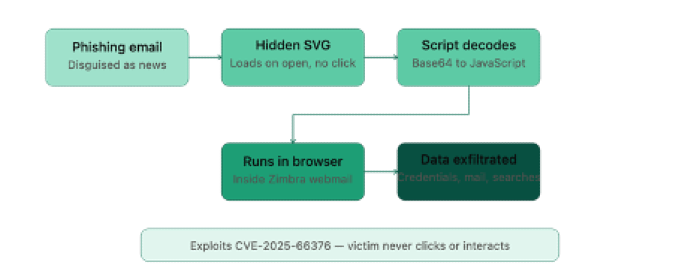
Unit 42's investigators note that the underlying malicious code has barely changed since the campaign began, suggesting the attackers consider the current toolkit reliable enough not to need reinvention — a sign of operational maturity rather than a rushed or improvised effort. What has changed constantly is the infrastructure behind it: researchers have tracked at least nine different IP addresses and nine different domains used as command-and-control points over the campaign's lifespan, each staying active for an average of just over a month before being retired or replaced. That rotation pattern is itself a tradecraft signal — infrastructure built to be disposable, so that even when defenders identify and block one server, the operation simply shifts to the next.
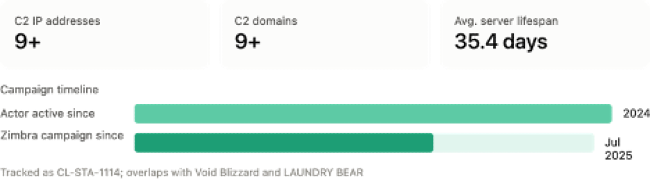
The strategic picture here is a familiar one for state-linked cyberespionage: rather than breaking into hardened government systems directly, the operation goes after the webmail platforms that ordinary organizations — across unspecified but described as critical sectors globally — depend on every day, exploiting the gap between how quickly software vulnerabilities are disclosed and how slowly many organizations actually patch them. Unpatched Zimbra servers remain actively targeted under this same vulnerability even as this report is published, meaning the exposure window for slow-moving organizations is still open.