One Click, One Mailbox, One Defense Contractor: The IEH Breach-318

August 10, 2026
IEH Corporation is not a household name, and that is exactly the point of the company it makes for defense supply chains. The Brooklyn-based manufacturer builds high-reliability hyperboloid connectors — small, unglamorous hardware that nonetheless shows up inside rotary-wing aircraft, fighter jets, airborne radar systems, satellites and spacecraft, military radios, torpedoes, and missile-defense systems including THAAD and Patriot. IEH reported just under $30 million in revenue for fiscal year 2026, a small company by almost any standard, sitting quietly inside some of the most sensitive supply chains in American defense. On August 4, the company disclosed in a filing with the Securities and Exchange Commission that a single phishing email had given an outside attacker full access to an employee's Microsoft 365 mailbox — and that the exposed contents potentially included export-controlled technical information.
The mechanics of the intrusion required no real technical sophistication at all, which is itself the case's most important detail. According to IEH's own filing, a threat actor using an alias impersonated a prospective business contact and sent an employee a hyperlink disguised as an ordinary Microsoft document-sharing link. The employee clicked it, landed on a fraudulent login page, and entered their Microsoft 365 credentials — handing the attacker complete access to the account. From there, the attacker reached email messages, attachments, customer communications, purchase orders, engineering-related documentation, and, in IEH's own words, "potentially export-controlled technical information." The company says it has found no evidence the material was copied or exfiltrated, though it acknowledges the data was accessible to the intruder throughout what it calls the "compromise period" — a period whose actual length IEH has not disclosed, beyond confirming that malicious mailbox rules had been created inside the account and had to be found and disabled during containment. That detail matters more than it might first appear: setting up mailbox rules is something an attacker generally does to establish a foothold or quietly redirect and hide future correspondence, which suggests whoever got in stayed long enough to plan for continued access rather than grabbing what was immediately visible and leaving.
The regulatory language IEH used is doing more work than it might look like on first read. IEH's connectors fall under the International Traffic in Arms Regulations and the Export Administration Regulations — the legal frameworks governing which defense-related technical data can be shared with whom, and under what conditions. If export-controlled information genuinely reached an unauthorized party, whether that party was a foreign intelligence service or an ordinary financially motivated criminal, the incident stops being simply a data breach and becomes a potential federal compliance violation layered on top of it, with its own separate reporting obligations and legal exposure. IEH has stressed that no data exfiltration has been confirmed, and that it does not currently expect the incident to materially affect its business or operations — language doing the necessary work of a public filing without foreclosing what the ongoing investigation might still turn up.
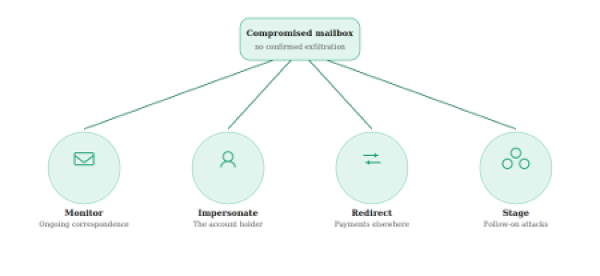
Nobody has attributed this intrusion to any specific actor, and there are good reasons for that caution to hold rather than collapse into a convenient narrative. Compromised mailboxes at small companies inside sensitive supply chains attract two very different kinds of attacker for two very different reasons: a state-linked intelligence service might want quiet, sustained access to engineering correspondence and export-controlled specifications precisely because a small connector manufacturer is a softer target than the prime contractors it feeds into, while an ordinary financially motivated criminal might see the same mailbox as raw material for business email compromise, payment redirection fraud, or a data-extortion sale with no interest in the defense content at all. Both Russia and China have been documented compromising US organizations for defense-related information over the past year, but nothing in IEH's disclosure points toward either specifically, and a compromised inbox with no confirmed exfiltration offers little for outside observers to reason from. What the case does demonstrate plainly is a structural gap in how breach severity gets judged: the absence of confirmed exfiltration in Microsoft 365 logs is not the same as confirmation that nothing was taken, since a capable attacker sitting inside a live mailbox can monitor ongoing correspondence, impersonate the account holder to redirect payments or extract further information, or quietly stage a follow-on attack against other organizations in the same supply chain — all without leaving the kind of bulk-download signature that breach-detection tooling is built to catch. For a company whose actual product is measured in single connectors rather than headline revenue, that gap between what was technically logged and what an attacker could plausibly have done during an undisclosed window inside a live account is the real story here, far more than whatever the eventual attribution turns out to be.