The Silence Is the Signal: China's Opaque Review of Palo Alto Networks- 317
August 9, 2026
China's Cyberspace Administration announced a cybersecurity review of Palo Alto Networks' products this month, and the entire public justification for it runs to a single formal sentence: the review is needed, the regulator says, "to ensure the safe and stable operation of critical information infrastructure, prevent cybersecurity risks and vulnerabilities, and safeguard national security." No vulnerability is named, no incident is referenced, and no timeline is given for when findings might land. Palo Alto Networks told reporters it maintains high standards across its global operations and that, for now, the review has no impact on its ability to serve customers or deliver products in China. Read on its own, the announcement is nearly content-free. Read against China's recent regulatory history and its broader campaign to displace foreign cybersecurity vendors, it looks considerably less arbitrary.
The precedent doing most of the interpretive work here is China's 2023 review of Micron, which unfolded in an almost identical pattern: a review announced without warning, a decision weeks later that Micron's products posed an unacceptable security risk to critical infrastructure operators, and essentially no public explanation of what the risk actually was. The practical effect was a de facto ban — Micron eventually withdrew its data-center and server products from the Chinese market entirely, losing billions of dollars in annual revenue, while domestic Chinese memory manufacturers, largely locked out of selling to American companies in turn, picked up the resulting opportunity. Micron's story does offer one data point that should reassure Palo Alto if it needs it: getting frozen out of a major market didn't permanently damage the company, since the AI-driven memory boom that followed drove prices high enough that the China restriction barely registers in Micron's financial results today. Losing a market stings considerably less when the rest of the world is buying everything you can produce anyway — though that comfort depends on a boom materializing for Palo Alto's own product category the way it did for memory chips, which is far from guaranteed.
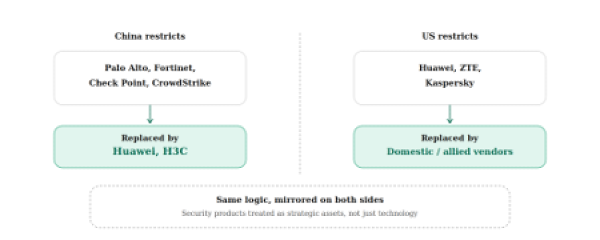
What makes the Palo Alto review look like more than an isolated technical inquiry is the policy context sitting directly behind it. In January, Chinese authorities reportedly instructed domestic firms to stop using security software from a list of American and Israeli vendors that already included Palo Alto Networks, alongside Fortinet, Check Point, CrowdStrike, and others, encouraging a switch to domestic alternatives instead. Chinese vendors including Huawei and H3C have moved quickly to fill exactly that gap, with H3C in particular marketing its own firewalls and security platforms explicitly as replacements for overseas technology. Viewed alongside that directive, a review with no stated grounds starts to look less like the beginning of a security investigation and more like a formality attached to a decision whose real logic is industrial policy: reducing dependence on foreign security vendors and creating room for domestic ones to grow into the space they vacate. Because Palo Alto does not break out its China-specific revenue publicly, the immediate financial exposure is difficult to quantify from outside the company, but the strategic stakes are clearer — any restriction creates an opening for Huawei and H3C to convert an administrative decision into market share.
This dynamic is not unique to China, which is precisely what makes it worth situating in a wider frame rather than treating as a one-sided act of protectionism. Washington and its allies have taken symmetrical measures against Chinese and Russian vendors on comparable national-security grounds: Huawei and ZTE remain effectively excluded from much of the Western telecom market, and the United States banned Kaspersky's antivirus and security software outright, arguing that the company's ties to Russia created unacceptable risk regardless of whether any specific product flaw was ever demonstrated. Beijing frames foreign technology as a potential vector for outside surveillance; Washington frames Chinese and Russian technology the same way. Both sides increasingly treat cybersecurity products less as ordinary commercial goods and more as strategic assets whose national origin matters as much as their technical merit — a cycle of reciprocal distrust in which the actual security properties of any given product risk becoming almost incidental to the decision of whether it gets to operate in a given market at all. Palo Alto's review may or may not turn up a genuine technical concern; either way, the silence surrounding it is doing exactly the work Beijing likely wants it to do; leaving Western observers uncertain whether they are looking at a security finding or an industrial-policy decision wearing a security finding's clothes.