Lotus Wiper: Cyber Sabotage and the Weaponization of Venezuela’s Energy Infrastructure- 152
April 22, 2026
The emergence of Lotus Wiper highlights a shift in cyber operations toward outright sabotage of critical infrastructure. Discovered by Kaspersky, the malware targeted Venezuela’s energy sector between late 2025 and early 2026, amid heightened geopolitical tensions. Unlike ransomware, it carries no financial motive—its purpose is to disrupt, disable, and permanently damage systems. This campaign reflects the growing use of cyber tools as strategic instruments to destabilize essential national infrastructure without direct military confrontation.
Unlike conventional ransomware, Lotus Wiper contains no mechanism for extortion, underscoring a clear intent to disable infrastructure rather than profit from it. Its deployment reflects a broader shift toward cyber operations designed to produce tangible, real-world consequences—disrupting energy production, paralyzing logistics, and undermining national stability.
This campaign illustrates how cyber capabilities are increasingly integrated into geopolitical strategies, operating as silent force multipliers that can precede or accompany political and military pressure. By targeting one of the most vital sectors of the Venezuelan state, Lotus Wiper signals a transition toward cyber-enabled sabotage as a central instrument of modern conflict.
The emergence of Lotus Wiper underscores a growing shift toward cyber operations designed not to exploit or extort, but to disable and destroy critical infrastructure. Discovered by Kaspersky, the malware was deployed in a targeted campaign against Venezuela’s energy and utilities sector between late 2025 and early 2026, in a context marked by rising geopolitical tensions and reported U.S. military activity in the country. Its timing and focus suggest a coordinated effort aligned with broader strategic objectives rather than isolated cybercriminal behavior.
At the operational level, Lotus Wiper follows a structured, multi-stage attack chain. Initial scripts prepare the environment by weakening defenses, coordinating execution across systems, and verifying whether the infected machine is part of a larger organizational network. This step is critical, as it allows the attackers to synchronize actions across multiple systems, maximizing impact. The malware then proceeds to systematically disrupt operations—logging out users, disabling network interfaces, and preventing administrative access—effectively isolating the environment before initiating destruction.
The destructive phase is both comprehensive and irreversible. Lotus Wiper deletes files, overwrites data, fills storage capacity, and removes recovery mechanisms. It goes further by wiping physical disk structures and erasing system-level records, ensuring that restoration is extremely difficult, if not impossible. Unlike ransomware, no payment demand is issued; the objective is clearly sabotage rather than profit.
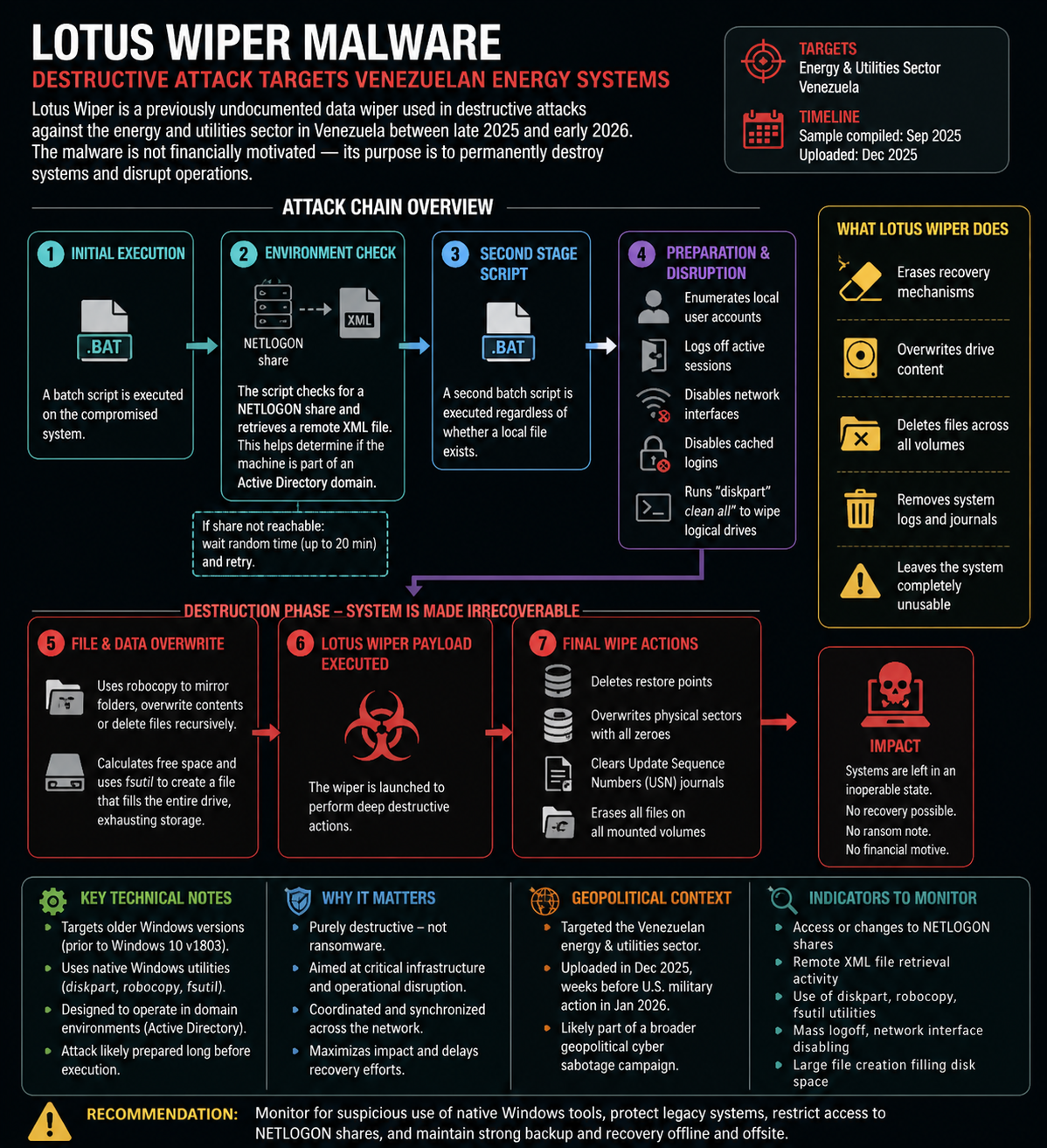
Technically, the malware reveals a strong understanding of enterprise environments. Its ability to interact with network structures such as shared directories and its focus on older Windows systems suggest prior reconnaissance and possibly prolonged access before activation. The coordinated nature of the attack, combined with the use of legitimate system tools to carry out destructive actions, reflects a deliberate effort to blend into normal operations until the final stage.
The attackers first run small scripts (simple command files) that:
• coordinate the attack across multiple machines
• weaken security protections
• disrupt normal system behavior 2- Attackers are targeting organized environments (companies, government, infrastructure):
The malware tries to access something called a shared company
network (Active Directory). Only if the system is connected to this network then the attack continues 3- Multiple systems to be hit at the same time
Once the network is available: the malware waits if needed (to avoid detection), then continues execution across machines. 4- The malware prevents defenders from reacting
The malware shuts down normal operations (logs users out, disables network connections, blocks login features, stops certain system services) 5- The malware starts destroying the system (It deletes files, overwrites data and replaces everything with meaningless data, removes recovery options, fills the hard drive completely) 6- The malware wipes the system at a deeper level (erases the structure of the hard drive itself, removes internal system logs, deletes restore points)
In a broader context, Lotus Wiper exemplifies the increasing use of cyber capabilities as instruments of geopolitical pressure. By targeting energy infrastructure—one of the most critical pillars of national stability—the operation highlights how cyberattacks can be used to generate real-world disruption without direct military engagement. As such campaigns become more sophisticated and strategically aligned, they signal a shift toward cyber-enabled sabotage as a central component of modern conflict dynamics.
Download the Full Report (pdf)