Listening to the Seabed: Denmark's Bet on Acoustic Sensing as a First Line of Maritime Defense- 257
July 19, 2026
Europe's undersea infrastructure — power interconnectors, data cables, offshore wind arrays — has become one of the continent's most exposed and least monitored strategic assets, a vulnerability the destruction of the Nord Stream pipelines made viscerally clear. Into that gap has stepped Triton Depth, a three-person Danish startup that has secured €1 million in pre-seed funding, notably including participation from Denmark's state-owned Export and Investment Fund, to build a scalable network of passive acoustic sensors capable of detecting and classifying underwater activity in real time.
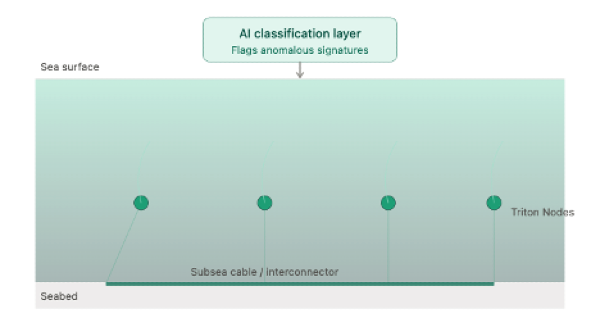
The technology itself is unglamorous by design: low-maintenance sensor clusters, termed Triton Nodes, that listen rather than actively scan, feeding acoustic signatures to an AI classification model. That restraint is deliberate. Triton Depth's founders are explicit that their approach is calibrated for a defense environment without the budgets of major naval powers — an "intelligence layer for the ocean," as the company frames it, meant to offer partial situational awareness at a fraction of the cost of traditional sonar or surveillance infrastructure, marketed as dual-use for both civilian and military applications.
What makes the funding notable is not the technology alone but the identity of one of its backers. A state investment fund taking a position in a three-person startup is a small transaction in isolation, but it fits a broader pattern of Nordic and Baltic states hedging against a security environment in which reliance on larger alliance partners feels increasingly uncertain, and in which subsea sabotage — of the kind Denmark and its neighbors have already experienced directly — no longer registers as a remote contingency. Whether Triton Depth's technology matures into an operationally significant capability remains to be seen, but the investment itself signals something concrete: a European state moving, in a small but deliberate way, to build indigenous means of watching a strategic domain it can no longer assume others will watch on its behalf.