A parking-lot camera as a weapon of war: how Russia turned Europe's own infrastructure into a targeting network- 291
July 23, 2026
Dutch intelligence has confirmed something that sounds almost mundane until its consequences are traced through: an ordinary internet-connected security camera — the kind mounted over a loading dock or beside a road — has become one of Russia's tools for locating and striking Ukrainian forces, and for quietly mapping military logistics across NATO and EU territory. No advanced hacking was required to make this possible. Just cameras left with factory-default passwords, and a state intelligence service patient enough to exploit that at scale.
The Netherlands' two intelligence services, the civilian AIVD and the military MIVD, issued a joint advisory on July 10 confirming that a Russian intelligence service has been systematically breaking into internet-connected IP cameras across the Netherlands, other EU and NATO states, and Ukraine, in an operation that has grown steadily since Russia's full-scale invasion began. The method itself requires no sophisticated exploit: operators simply scan the internet for cameras, identify the make and model, and walk in through devices still running default passwords, outdated software, or unchanged factory settings — security failures common enough that Dutch officials describe the process as "relatively simple."
Once inside a camera feed, the operation applies automated image-recognition software to scan the video for military vehicles and the cargo they're transporting. In Ukraine, this has a direct and lethal application: the advisory states plainly that intelligence gathered this way — including the locations of Ukrainian military personnel — has been used to help Russian forces strike Ukrainian troops and equipment. A camera that happens to overlook a transport route or a loading area effectively becomes a targeting sensor, feeding coordinates into a kill chain that starts with nothing more than an unchanged password.
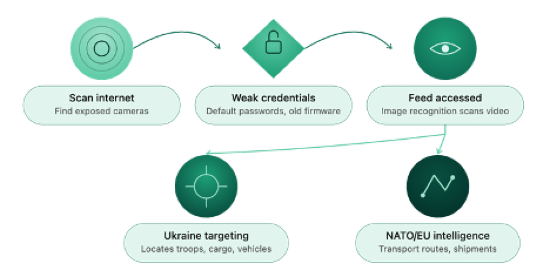
Beyond the battlefield, the same technique serves a broader intelligence-gathering purpose across NATO and EU territory: monitoring military transport routes and weapons shipments bound for Kyiv, and collecting other militarily useful information not directly tied to the Ukraine war. Dutch services confirmed they found a small number of compromised cameras positioned directly on military logistics routes inside the Netherlands itself. Importantly, the advisory stops short of claiming this camera-derived intelligence has yet been used for attacks outside Ukraine — but it frames that as a demonstrated capability rather than a remote possibility, meaning the same playbook could be extended to a future conflict involving NATO territory directly.
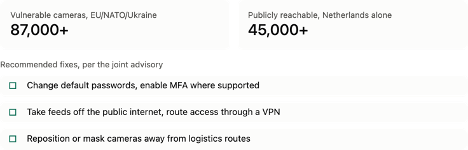
The scale of the exposure is what turns this from a theoretical risk into an active one. Independent research cited in the advisory found more than 87,000 internet-connected cameras across EU, NATO, and Ukrainian territory running software with known, exploitable vulnerabilities — and in the Netherlands alone, more than 45,000 cameras are reachable from the open internet. The advisory's recommended fixes are unglamorous but concrete: position cameras to avoid capturing logistics routes and sensitive areas in the first place, mask or blur sensitive zones in the field of view, strip location data from video streams, take live feeds off the public internet unless there's a genuine need, disable automatic port-forwarding features, route remote access through a VPN, change default passwords immediately, separate administrative access from ordinary viewing access, and enable multi-factor authentication wherever supported. The advisory also flags a procurement dimension worth noting for any organization buying this hardware going forward: China, Russia, and Iran are named as states actively running offensive cyber programs against Dutch and European interests, a factor the Dutch services suggest should inform decisions about camera hardware origin.
What this case demonstrates, more than any single technique, is how directly civilian infrastructure has been absorbed into Russia's military intelligence apparatus — not through cutting-edge cyberweapons, but through the accumulated neglect of basic device security across hundreds of thousands of ordinary, everyday cameras.