A breach nobody's attributed yet, hitting the platform that's coordinating World Cup security- 253

July 1, 2026
The Department of Homeland Security has confirmed that an unknown threat actor breached the Homeland Security Information Network, the platform federal, state, local, and private-sector partners rely on to share sensitive but unclassified threat information — and the timing is difficult to separate from context: the intrusion occurred sometime between late May and early June, precisely as the United States is coordinating security for World Cup matches being hosted across the country.
DHS's own account of the incident is notably narrow in what it confirms. A department spokesperson acknowledged the breach affected "a specific, unclassified legacy information sharing environment," emphasizing that classified networks were not touched, that affected systems were isolated immediately upon discovery, and that HSIN remains operational for its partners while a forensic investigation continues. What DHS has not said is who was responsible — the department has not attributed the intrusion to any specific actor or foreign government — nor has it clarified whether any documents were actually exfiltrated during the breach. According to Nextgov, which first reported the incident, the attackers targeted both HSIN's core servers and a separate SharePoint system used for interagency collaboration, prompting DHS's Office of Intelligence and Analysis to conduct a damage assessment whose findings have not been made public.
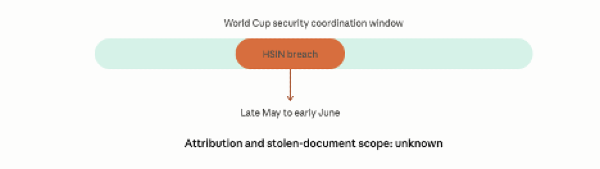
What makes the platform's exposure genuinely consequential is what HSIN is actually built to do. Beyond routine information sharing, the network supports real-time alerts and incident management, coordination on planned-event security, and the exchange of information specifically about persons of interest and potential threats — the operational backbone connecting federal agencies with the state, local, and private-sector partners who handle security on the ground. With the U.S. currently overseeing security planning for World Cup games hosted nationwide, Nextgov's reporting raises a specific and reasonable concern: a breach of this particular system, at this particular moment, could plausibly have exposed security planning details, interagency coordination procedures, or incident-response protocols tied directly to protecting one of the highest-profile international events the country will host this year.
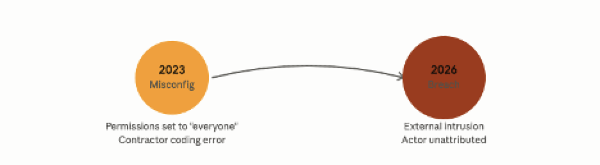
This is not HSIN's first documented security failure. In 2023, an access misconfiguration traced to a contractor's coding error set permissions within HSIN-Intel, the platform's intelligence-focused section, to "everyone" rather than the intended limited group of authorized users — exposing sensitive U.S. person data and other personally identifiable information to the entire HSIN user base, according to an internal DHS memo reviewed by Wired. That earlier incident was a configuration failure rather than an external intrusion, but read alongside this year's still-unattributed breach, it establishes a pattern of vulnerability in a system explicitly designed to be trusted with exactly the category of information — threat intelligence, persons of interest, event security coordination — that depends most on staying protected.