A blank marketing email as a spy's front door: how suspected Chinese operators are quietly reading university mailboxes- 285

July 9, 2026
A suspected Chinese espionage group has spent months breaking into the email accounts of physics and engineering researchers at a small number of major US and Canadian universities, using nothing more than an ordinary-looking, forgettable email as the opening move — and deliberately keeping its footprint so small that most of what it touches probably goes unnoticed by design.
Proofpoint researchers, who track the group as UNK_MassTraction, directly confirmed fewer than ten universities compromised since the campaign began in May, though they caution their honest best guess for the true scope is "a few dozen" — an estimate they're explicit is not something their data can actually prove. [2]The operation is deliberately narrow in who it targets: individuals in departments tied to national security work, or in astrophysics and particle physics specifically — research areas that feed directly into Beijing's intelligence-collection priorities and are accordingly popular targets for Chinese state-linked hacking crews.

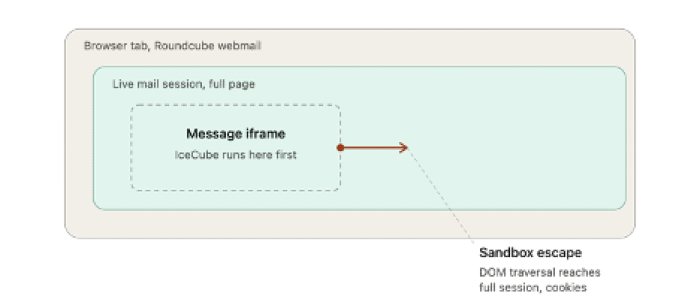
What makes the entry method notable is how little it demands of the victim. The operation exploits a flaw in Roundcube, a widely used webmail platform, that requires nothing more than opening the email in the browser-based mail client — no attachment to download, no link to click, no credentials to type. The lure emails themselves are deliberately unremarkable, sometimes resembling generic university marketing messages, which researchers believe may be a deliberate choice: a bland, forgettable email is more likely to be opened and then simply ignored rather than investigated, which is all the attackers actually need. Notably, the specific university departments were seemingly hand-picked for already running outdated, vulnerable versions of Roundcube — meaning the operators had already scouted their targets' software before ever sending an email. Once the email is opened, hidden code embedded in the message body runs automatically inside the webmail page. This code first breaks out of the restricted, sandboxed portion of the browser page that's meant to contain it — the same kind of isolation a video ad or embedded widget normally lives inside — gaining access to the full page and the user's already-logged-in mail session. From there, it functions as a full credential and session-token stealer: harvesting usernames, passwords, session cookies, and browser details like screen size and language settings, and sending all of it back to the attackers' server. It then reuses the victim's own active session to exploit a second Roundcube vulnerability, this one allowing the attackers to install a web-based remote-access panel and a separate backdoor tool called VShell — a tool built specifically for and used almost exclusively by Chinese state-linked hacking groups for ongoing remote control, file access, and post-compromise activity. As of June, researchers also observed the group adding a backup delivery method for cases where this main access tool fails to install, a resilience upgrade over earlier versions of the campaign, where a failed attempt simply meant the intrusion stalled.