The Elected Leader: How Turla Rebuilt Kazuar as a Peer-to-Peer Espionage Botnet- 186

June 13, 2026
Turla has been running espionage operations for more than two decades. In that time, defenders have learned its infrastructure, mapped its malware, and disrupted its campaigns. Turla's answer, documented in a May 2026 Microsoft analysis, is an architecture designed to make disruption irrelevant: a peer-to-peer botnet where only one infected host communicates externally at any moment, where that host can be replaced automatically if burned, and where the majority of the compromised population remains permanently invisible to network monitoring. This is not an escalation of capability. It is the engineering of resilience.
Turla — also tracked as Secret Blizzard, Snake, Uroburos, and Waterbug, assessed by CISA to be affiliated with Center 16 of Russia's Federal Security Service — has been conducting espionage operations since at least 2004. Its Kazuar backdoor has been a documented component of those operations for years. What Microsoft's researchers documented in May 2026 is not a new actor or a new tool but a structural evolution of existing capability that substantially increases Kazuar's resilience and makes it significantly harder to detect and disrupt: the transformation of a traditional backdoor into a modular peer-to-peer botnet designed for long-term, low-observable intelligence collection.
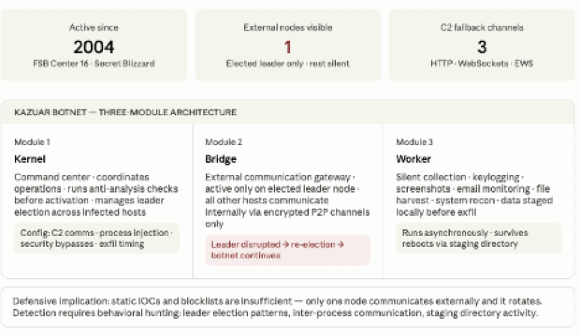
The architecture Microsoft describes has three core modules — Kernel, Bridge, and Worker — each handling a distinct function, cooperating to distribute the operational load across compromised systems while minimizing the external network footprint that defenders would observe. The Kernel module acts as the command center, coordinating operations, distributing work among infected hosts, and performing anti-analysis checks before the malware fully activates on a new system. Worker modules handle the actual collection tasks: keylogging, screenshot capture, email monitoring, file harvesting, system reconnaissance covering installed software, security products, network activity, USB devices, running processes, browser history, DNS cache, and Outlook data. The Bridge module is the communication gateway — but here is the critical design decision that makes the entire architecture difficult to disrupt. Rather than allowing every compromised machine to communicate directly with attacker-controlled infrastructure, Kazuar routes all external traffic through a single elected leader node. The election process selects one host from among the compromised population to serve as the external-facing relay. All other infected systems remain in silent mode, communicating internally through encrypted peer-to-peer channels. The elected leader uses the Bridge module to send and receive commands, tasks, and stolen data. From the outside, a network running Kazuar looks like a single host with periodic encrypted outbound connections. The rest of the compromised population is invisible.
The design's operational consequences are significant. Blocking or burning the leader node does not disrupt the botnet — Kazuar supports a leader re-election process, so the infected population simply selects a new leader and continues operating. The multiple fallback communication channels — HTTP, WebSockets, and Exchange Web Services — mean that blocking one protocol does not take down communications. Stolen information is encrypted and staged locally in a dedicated working directory before exfiltration, separating collection from transmission, so a network disruption during exfiltration loses a transmission window but not the collected data. The modular architecture means that if one module is detected and removed, the others continue functioning and can reload the missing component. Microsoft's assessment is that this architecture reflects Secret Blizzard's broader objective of gaining long-term access to systems for intelligence collection — not the rapid extraction and exit model of financially motivated attackers, but persistent, patient, deep-access espionage with an architecture designed to survive the defensive responses that would disrupt less resilient implants.
The malware uses Google Protocol Buffers for structured inter-module communication — a mature serialization format that makes message parsing efficient and supports the complex task-and-response model the botnet requires. Droppers decrypt payloads only on targeted systems. Lightweight .NET loaders execute Kazuar modules directly in memory to reduce on-disk artifacts. The configuration is extensive and dynamically adjustable from the command server, covering communication parameters, process injection targets, security bypasses, data exfiltration timing, file harvesting rules, and keylogging behavior. Operators can reconfigure a deployed implant without redeployment.
Microsoft's guidance for defenders reflects the architecture's sophistication: focus less on individual malware samples and more on the behaviors that keep the botnet functioning — leader election patterns, inter-process communication signatures, staging directory activity, and the periodic encrypted outbound connections that mark external communication. Static indicators of compromise, signatures, and known bad IP addresses are insufficient against a botnet whose external surface changes when a leader is disrupted and whose majority of infected hosts never communicate externally at all. Kazuar is designed to be hunted behaviorally or not at all.