Nothing to See Here: The Cyber Sabotage Framework That Preceded Stuxnet by Five Years- 202

June 24, 2026
The historical understanding of offensive cyber operations is being re-evaluated following the discovery of a sophisticated framework known as fast16. While Stuxnet is traditionally recognized as the first cyberweapon designed to cause physical-world destruction, a research suggests that a far more subtle and mature framework existed as early as 2005. Rather than inducing mechanical failure, this framework silently corrupted floating-point calculations within precision engineering simulation software, systematically introducing errors into structural and physical process models. This report examines the technical sophistication of fast16, its modular design, and its historical target profile, which included engineering suites utilized in sensitive programs ranging from nuclear weapons development to civil construction and marine simulation.
Stuxnet has occupied a singular position in the history of offensive cyber operations: the first publicly known cyberweapon designed to cause physical-world consequences, the moment that demonstrated a state could reach through software into industrial machinery and destroy it. That position may need revision. SentinelOne's threat researchers, tracing the lineage of Lua-based implants used by Flame, Animal Farm, and Project Sauron, found a framework compiled in 2005 — five years before Stuxnet's discovery — that attempted something subtler and in several respects more sophisticated: not destroying centrifuges through mechanical stress, but silently corrupting the floating-point calculations of precision engineering simulation software, introducing systematic errors into the numbers used to model physical processes, structural designs, and materials behavior.
The framework is called fast16. Its carrier binary, svcmgmt.exe, was uploaded to VirusTotal in 2016 and sat undetected for nearly a decade. As of the Black Hat Asia disclosure it still receives almost no antivirus detections, nearly twenty years after its compilation date. The researchers found it because they were looking for the earliest use of an embedded Lua virtual machine in Windows malware — the same architectural signature that appears in several known apex nation-state implants — and the search surfaced a 2005 sample whose internal structures were incompatible with anything a developer of that era should have been writing. The techniques were too mature, the design too modular, the operational security too careful.
The framework has three principal components. The carrier, svcmgmt.exe, embeds an encrypted Lua 5.0 virtual machine and a worm architecture referred to internally as "wormlets" — a cluster munition design that carries multiple payloads and propagates them across shared network infrastructure by exploiting weak administrative credentials on file shares, all through standard Windows service-control APIs rather than custom network protocols. The pre-installation kill-switch checks for seventeen specific security products before deploying, including Kaspersky, Symantec, F-Secure, and McAfee personal firewalls — a product list that reflects exactly what the operators expected to find on their target networks in the mid-2000s. The kernel driver, fast16.sys, is the payload that matters: a boot-start filesystem component that intercepts executable files as they are read from disk and patches them in memory according to a rule-driven engine before they execute. It targets executables compiled with the Intel C/C++ compiler specifically — the operators knew which toolchain built their target software — and once it identifies a candidate, it injects a block of floating-point unit instructions that corrupts precision arithmetic results in a controlled way, altering calculations without producing errors or crashes that would alert an operator to the presence of a problem.
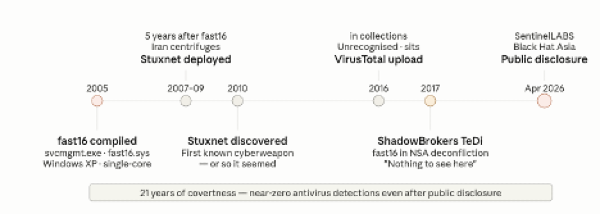
The sabotage mechanism's sophistication lies in what it does not do. It does not encrypt. It does not exfiltrate. It does not trigger any indicator that a defender looking for malicious activity would recognize as such. It produces wrong numbers that look right. The researchers matched fast16's patching rules against period-appropriate software corpora and found three candidates: LS-DYNA 970, the engineering simulation suite used for crash testing, explosion modeling, and structural analysis, which has been publicly cited in studies of Iran's AMAD nuclear weapons development program; PKPM, the dominant structural engineering CAD suite for Chinese civil construction; and MOHID, a Portuguese hydrodynamic modeling platform used for marine and environmental simulation. The combination resists a clean single-country attribution, but LS-DYNA's documented role in Iran's nuclear weapons research makes its presence in the target list impossible to ignore in the context of early-to-mid-2000s Western intelligence priorities.
The ShadowBrokers link is the other forensic pillar. In April 2017, nearly twelve years after fast16's compilation, the infamous leak of NSA tools that the ShadowBrokers published included the Territorial Dispute deconfliction list — a database used by NSA operators to identify "friendly" tools encountered on target machines and avoid interfering with allied operations. The name "fast16" appears on that list, with an associated evasion signature that reads: "*** Nothing to see here – carry on ***." The sardonic label, embedded in an operational database used by people who would know exactly what they were seeing, is both a fingerprint of the tool's creators' professional culture and a confirmation that this framework was known to and used by — or at minimum deconflicted against — the US intelligence community's most sensitive offensive operations for years.
The compiler footprint adds a final layer to the attribution picture. Strings embedded in fast16's binaries use the @(#) prefix characteristic of early Unix SCCS and RCS source control systems from the 1970s and 1980s — an anachronism in mid-2000s Windows kernel development that strongly suggests the authors' development culture and toolchain came from older, high-security Unix environments associated with government or military-grade engineering work. These are not the artifacts of a criminal developer or even a typical intelligence agency contractor. They are the fingerprints of a long-running program whose engineers had been writing serious software since before Windows existed.
In the broader history of offensive cyber operations, fast16 matters because it reframes what Stuxnet was. Stuxnet was not the beginning of state-level cyber sabotage against physical targets. It was the moment such operations became publicly visible. The quieter predecessor, designed to produce errors that could persist undetected in the calculations underlying physical engineering programs for years before any consequence materialized, may have been not only more restrained but more dangerous: a framework that could undermine scientific programs, degrade engineered systems, or contribute to catastrophic failures in ways that would never be traceable to software. "fast16 was the silent harbinger of a new form of statecraft," the SentinelLABS researchers wrote, "successful in its covertness until today." The researchers also disclosed their findings to the vendors of the targeted simulation software, because, as Kamluk noted at Black Hat Asia, if fast16 ever ran against those applications, there may still be outputs from twenty years ago whose results no one has yet thought to question.