The New Architecture of Risk: How BloodHound 8.0 Changes the Defense Methodology
August 6, 2025
The core doctrine of cybersecurity is being rewritten. For years, the field has fought a segmented battle, defending Microsoft Active Directory, cloud platforms, and SaaS applications as separate fronts. SpecterOps' BloodHound 8.0 shatters this fragmented methodology with the introduction of OpenGraph, a paradigm shift that redefines attack path management. This release moves beyond a singular focus on Microsoft to establish a universal language for risk across the entire enterprise stack. By seamlessly integrating systems like GitHub, Snowflake, and SQL Server into a single, holistic security map, BloodHound 8.0 doesn’t just represent an update—it signals a fundamental evolution in how we understand and defend against modern adversarial campaigns.
SpecterOps, a highly respected cybersecurity company, primarily known for its focus on adversary emulation and security assessments, where they mimic the tactics, techniques, and procedures (TTPs) of real-world threat actors to test an organization's defenses.
They specialize in helping organizations understand and defend against sophisticated cyber-attacks.
While Traditional security looks at permissions in isolation (e.g., "Does this user have admin rights on this PC?"), SpecterOps' most famous and widely used open-source tool BloodHound's genius is in revealing the chains of relationships between objects. It shows how an attacker can move from a low-level, compromised user account (e.g., from a phishing email) all the way to full domain administrator privileges by "hopping" through a series of misconfigured permissions. bloodhound arguably the industry standard for analyzing attack paths within Active Directory and Azure Active Directory environments.
BloodHound automatically finds and maps all these possible "attack paths" for an attacker.
This tool is efficiently escalating privileges and moving laterally through a network, quickly identifying the easiest path to complete domain compromise.
Nowadays SpecterOps announces a major update, BloodHound 8.0, which shifts the tool from being a specialist in Microsoft environments to a universal language for understanding attack paths across a company's entire digital landscape.
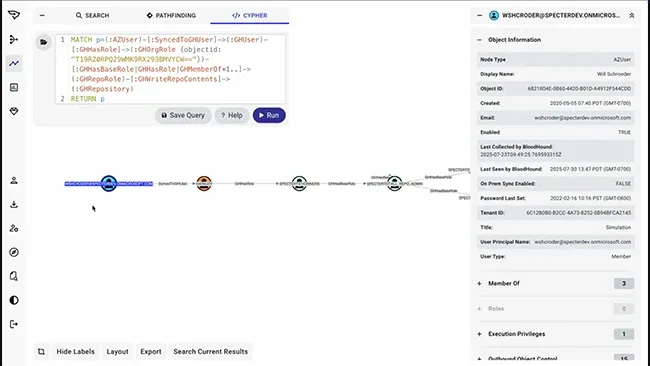
The core of this revolution is a feature called BloodHound OpenGraph. OpenGraph teaches BloodHound to understand the security relationships within dozens of other critical systems—like GitHub, Snowflake, and SQL Server—and, most importantly, how they connect to each other.
This allows defenders to build a single, massive map of their entire technology stack. Instead of having separate, isolated views of different systems, they can now see how a compromised account in GitHub could be used to access data in Snowflake, which then provides access to a critical SQL server, ultimately leading to a domain admin. It reveals attack paths that were previously invisible because they crossed between different types of systems.
The update also includes several key enhancements:
Microsoft PIM Support [privileged identity management]: It now tracks temporary, "just-in-time" admin roles. This is crucial because a permanent admin role is always a risk, but a temporary one can be forgotten and left active, creating a hidden attack path. BloodHound can now find those.
· New Integrations (ServiceNow, Duo): These make BloodHound more practical for day-to-day defense. ServiceNow integration automatically creates tickets for found vulnerabilities, streamlining fixes. Duo integration adds strong two-factor authentication to protect the BloodHound tool itself.
· Privilege Zones: This is a new strategy for prioritizing risk. Instead of just saying "this path leads to an admin," it allows teams to define their most critical assets (e.g., servers that handle payments or medical data) and then find all attack paths that lead specifically to those systems. This helps teams focus on what matters most to their business.
The release of BloodHound 8.0, and particularly OpenGraph, is not just an update; it's a fundamental expansion of scope and philosophy.
1. From Microsoft-Centric to Universal: With OpenGraph, SpecterOps is solving the next big problem: the modern enterprise uses a complex mix of many platforms (SaaS, cloud, databases). Attackers don't care if a system is Microsoft or not; they just follow the path of least resistance. BloodHound 8.0 now allows defenders to see the environment through the attacker's lens, regardless of technology.
2. The Power of the Community: By making OpenGraph a framework that others can build upon, SpecterOps is leveraging the entire cybersecurity community. Researchers and developers can now create "collections" for new systems (like Okta, AWS, etc.), and everyone benefits. This ensures BloodHound can continuously evolve to understand new attack surfaces faster than any single company could manage alone.
3. Maturing from a Tool to a Platform: The new integrations (ServiceNow, Duo) and features (Privilege Zones) show that BloodHound is maturing. It's no longer just a tool for experts to find problems. It is becoming a platform that connects directly into business workflows (ticketing), enforces security controls (MFA), and helps prioritize based on business risk, not just technical severity. This is essential for adoption by large enterprises.
Download the Full Report (pdf)