Israel Under Digital Siege: The Next War Without Tanks

December 12, 2025
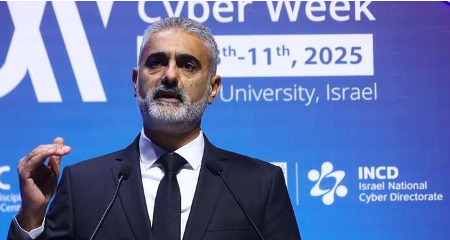
A senior Israeli cyber official is warning that the next war against Israel may not begin with rockets or armored columns, but with keystrokes. Speaking at Cyber Week in Tel Aviv, Brig. Gen. (res.) Yossi Karadi outlined a scenario in which a state can be strategically paralyzed through cyberspace alone. His briefing describes not a hypothetical future, but an operational reality already taking shape—one in which civilian life, psychological resilience, and national sovereignty are directly targeted through digital means.
Karadi’s core message is stark: modern war is shifting decisively into the digital domain. He argues that conflicts will increasingly begin, unfold, and potentially conclude without conventional military maneuvers. Instead, they will rely on coordinated cyber operations designed to disable a society from within. He calls this condition a “digital siege”—a sustained campaign in which electricity grids fail, water systems are compromised, communications collapse, and traffic systems cease to function, all triggered remotely.
This concept is not rhetorical. Karadi frames it as the endpoint of a 15-year evolution in state-sponsored cyber warfare. In its early phase, cyber operations were largely covert and restrained. They focused on espionage or highly precise sabotage against military or strategic targets, carefully avoiding civilian spillover. Stuxnet, exposed in 2010, is presented as the archetype of this era: a precision tool aimed narrowly at Iran’s nuclear centrifuges, engineered to minimize collateral damage. It demonstrated capability, not mass disruption.
The turning point came when cyber operations crossed into direct civilian impact. Karadi identifies the Russian Sandworm attacks on Ukraine’s power grid as a decisive moment. For the first time, cyber weapons were used to deliberately plunge civilians into darkness and cold, signaling that societal disruption itself had become a legitimate objective. Around the same period, the WannaCry ransomware outbreak demonstrated another dimension of danger: cyber tools, once released, could escape control and cripple hospitals and emergency services worldwide. Cyber conflict was no longer contained, predictable, or limited to battlefields.
According to Karadi, the current phase marks a further escalation. Iran, he argues, has embraced what can be described as “cyber terror.” The aim is no longer disruption alone, but mass harm and intimidation. The attempted manipulation of chlorine levels in Israel’s water system in 2020 stands as a defining example. Had it succeeded, it could have caused large-scale civilian casualties without a single explosive device.
Since then, Iranian-linked cyber activity has increasingly focused on Israel’s civilian infrastructure. Hospitals, power systems, public alert mechanisms, and other soft targets have been repeatedly probed or attacked. These operations are paired with persistent influence campaigns intended to erode public confidence and resilience.
A critical insight from Karadi’s remarks is the use of deniability through proxy actors. He revealed that an apparent criminal ransomware attack on Shamir Medical Center during Yom Kippur—attributed publicly to the Qilin ransomware group—was in fact linked to an Iranian state team. This blending of criminal and state cyber activity deliberately obscures attribution, complicating deterrence and response. Karadi notes that this pattern mirrors assessments in the United States and Europe, where Chinese groups such as Volt Typhoon are believed to be embedding themselves in critical infrastructure not for immediate gain, but for future strategic activation.
The boundary between cybercrime and cyber warfare is rapidly dissolving. Ransomware groups, influence operators, and intelligence services increasingly operate in overlapping ecosystems, providing states with plausible deniability while expanding their operational reach.
Karadi also describes a new level of integration between cyber operations and kinetic warfare. During Operation “Am Kalavi,” Iranian activity followed a hybrid model. In one case, a missile strike on the Weizmann Institute was synchronized with a cyber intrusion into the institute’s security cameras, allowing attackers to capture and exploit real-time imagery of the impact. Simultaneously, staff members were targeted with threatening emails and leaked personal data. The objective was not only physical damage, but psychological amplification—fear, humiliation, and loss of control.
This mirrors tactics observed in Ukraine, where cyberattacks on communications infrastructure were paired with artillery strikes to isolate populations, suppress information flow, and intensify panic. Karadi emphasizes that Israel is now facing psychological warfare at an unprecedented scale. During the operation, Israeli cyber defenders identified approximately 1,200 distinct influence campaigns. Millions of Israelis were exposed to false narratives, manipulated content, and intimidation efforts designed to fracture social cohesion.
The scale places Israel among the most targeted nations globally. Drawing on Microsoft data, Karadi noted that Israel accounts for roughly 3.5 percent of all cyberattacks worldwide, ranking third globally despite its small population. This level of targeting is usually associated with major powers, underscoring Israel’s position on a continuous digital front line.
Karadi closes with a dual warning and opportunity. Israel’s deep reliance on digital systems, combined with the rapid integration of artificial intelligence, dramatically expands both defensive potential and offensive vulnerability. AI increases efficiency and resilience, but it also gives attackers unprecedented scale, speed, and adaptability. In such an environment, cyber operations become as decisive as missiles or aircraft.
The implicit conclusion is clear: future wars will not be fought only at borders or in the air. They will be fought inside networks, minds, and essential services. In that battlefield, societal resilience becomes a strategic asset, and the keyboard is elevated to a weapon of war.