Fifty Thousand Front Doors: Iran's Suspected Water-Sector Campaign Exposes the Cost of a Fragmented Grid- 341
August 15, 2026
When cyber intruders locked operators out of the water treatment plant in Braham, Minnesota, on a Sunday morning in late July, the town of 1,700 people lost the ability to see or control its own water system for two hours — not because the attackers had breached anything sophisticated, but because the programmable logic controller running the plant had been sitting exposed to the open internet. What began as a single Minnesota incident has since widened into a multistate campaign, suspected but not officially attributed to Iran, that has laid bare a structural vulnerability in American water infrastructure far more consequential than any single town's two-hour outage: a sector built from roughly fifty thousand disconnected municipal systems, most too small, too underfunded, and too short-staffed to keep pace with an adversary that needs only a few exposed devices and a working password-reset script.
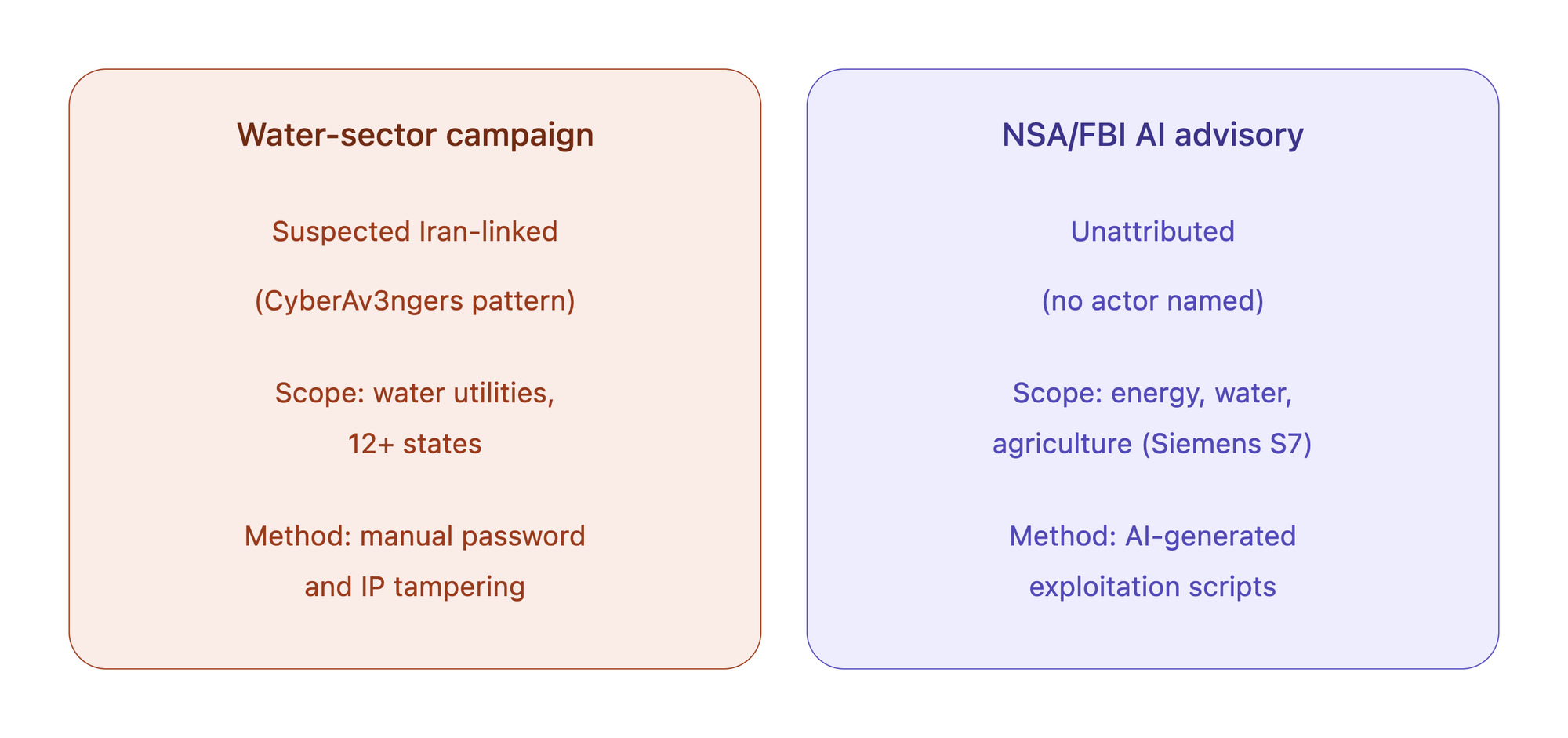
The campaign surfaced publicly on July 26 and 27, when more than thirty community water systems across Minnesota reported malicious activity on their operational-technology networks. Minnesota IT Services confirmed that most of the affected utilities used remote monitoring and control technology, and that being "impacted" meant investigators had confirmed malicious activity involving that technology — not necessarily a disrupted water supply. Braham was the exception: its operating controls for the well and treatment plant were shut down entirely, leaving the city reliant on stored water-tower reserves until service was restored. Nearby Plymouth, a city of roughly eighty thousand, saw its water-infrastructure communications disrupted before being restored by the following afternoon, with no impact on water levels or quality. Cybersecurity firm Tenable told reporters the intrusion methods bore the signature of CyberAv3ngers, the Iran-linked group with a long history of targeting small water utilities and municipal facilities — including a 2020 campaign against Israeli water systems via vulnerable cellular routers, and, in 2016, a US Justice Department case charging Iranian hackers over an intrusion into a small dam near New York City.
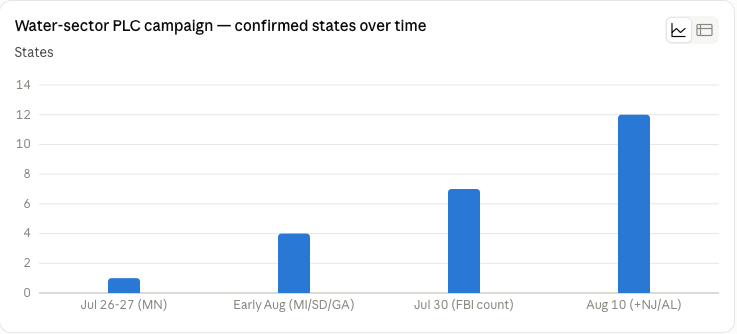
The campaign did not stay confined to Minnesota. Within days, Michigan, South Dakota and Georgia had confirmed intrusions consistent with the same pattern; by August 10, New Jersey and Alabama had joined the list, bringing the confirmed tally to at least a dozen states, according to reporting that cited federal sources. Georgia's Clayton County Water Authority experienced the most serious documented disruption, a pressure drop that forced a temporary boil-water advisory before service was restored within hours. The FBI, in a cyber alert, described the technical mechanism in detail: malicious actors were targeting internet-exposed Rockwell Automation MicroLogix 1100 and 1400 series controllers, remotely modifying IP addresses and passwords in ways that caused operators to lose visibility into — and in some cases control over — connected equipment. The bureau noted that similarities in third-party-provided network configurations across multiple victims may have let the same techniques succeed repeatedly across otherwise unrelated utilities, and that the operational consequences observed included pressure loss and, in some cases, flooding, with pressure loss carrying the added risk of allowing untreated groundwater to infiltrate distribution pipes. Federal agencies had already updated an April advisory to note that Iran-linked actors were pursuing controllers beyond Rockwell's product line, including Schneider Electric's Modicon M340 and Siemens's S7-1200 series, and cybersecurity firm Censys estimated that roughly ten thousand Rockwell, Siemens and Schneider PLCs remain reachable from the open internet, though how many are genuinely exploitable remains unclear. A non-public assessment from WaterISAC, the water sector's information-sharing body, reportedly found the intrusions "aligned" with prior Iran-linked campaigns, even as no federal agency has issued a formal public attribution.
The campaign's timing gave it an unmistakable geopolitical charge. Cynthia Kaiser, formerly the FBI cyber division's deputy assistant director and now senior vice president at Halcyon's Ransomware Research Center, argued that Iran's documented history and clear motivation left little room for alternative explanations — "when it walks like a duck and talks like a duck, it's really important to call it out," she said. That reading gained further support from a parallel episode: the pro-Iran group Handala claimed responsibility for separate attacks against medical device maker Stryker and payment processor Verifone, framing the intrusions as retaliation for the US-Israeli military operation against Iran, and specifically for the bombing of a school in Minab that killed more than 150 people — an incident a US military investigation attributed to the inadvertent engagement of the school during a strike on a nearby military installation. Whether or not the water-sector campaign and the Handala retaliation are operationally connected, both point to the same dynamic: a live military and intelligence confrontation with Iran translating directly into cyber operations against American civilian infrastructure. Speaking at DEF CON, retired General and former NSA director Paul Nakasone argued that attribution nuance matters less than capability and intent when both are already established: "there's an intent — we're in conflict with Iran," he said, while calling for water-system controllers to be disconnected from the internet entirely and describing the sector's core problem in structural terms — fifty thousand separate water municipalities supplying ninety percent of the country's water, most without dedicated cybersecurity staff. Industry technologists interviewed by Dark Reading offered a granular version of the same argument: PLCs were engineered for physical isolation, not internet exposure, and often gain unintended connectivity through field technicians and third-party integrators installing cellular modems or remote-access links without informing central IT or OT teams — a pattern compounded, according to Nozomi Networks field CISO Markus Mueller, by a sector of some 170,000 mostly small, decentralized utilities that simply lack the funding or mandate to secure what they operate.
That structural fragility took on a sharper edge three weeks into the campaign, when the NSA and FBI issued a separate advisory — deliberately unattributed and explicitly broader in scope than the water sector alone — warning of an active campaign using AI-generated exploitation scripts against internet-exposed Siemens S7 series PLCs across the energy, water and agricultural sectors. The agencies described threat actors conducting reconnaissance with AI-assisted tooling disguised as legitimate monitoring software, calling the use of artificial intelligence to generate working ICS exploitation code "an evolution in threat actor capabilities" that sharply reduces the technical expertise and time previously required to weaponize a known vulnerability. Industrial-technology expert Brian Proctor, CEO of OT pentesting firm Frenos, framed the shift starkly: where expertise once stood between a published vulnerability and a working exploit, "the barrier that used to be expertise is now time, and time is getting shorter." Proctor's more troubling observation concerned what the advisory implicitly acknowledged — that most PLC operators do not know their systems are internet-exposed in the first place, because the exposure was introduced by a third-party vendor rather than the utility itself. The endpoint he described was not a data breach but something closer to what Minnesota had already glimpsed at smaller scale: "loss of view, loss of control, and a physical process running in a state nobody in the control room can see." Whether or not this AI-tooling campaign is ultimately linked to the same actors behind the water-sector intrusions, it describes the same attack surface maturing into a faster, cheaper, and more automatable threat — one for which the current wave of state-by-state water utility attacks may prove to have been only the opening phase.