As Russia's Grip Loosens, China's Spies Move Into Central Asia's Economic Ministries- 343
August 22, 2026
A cyberespionage campaign that Bitdefender researchers have named SilkParasite offers a rare, detailed look at how a state's intelligence priorities can follow its economic footprint: seven previously unknown or little-documented malware families, deployed against government ministries across nearly all of Central Asia and neighboring Georgia, in an operation Bitdefender assesses with medium confidence to be linked to Chinese cyberespionage activity — not because Beijing's hand is nowhere in evidence, but because the campaign's targeting maps precisely onto a region where Russia's traditional influence has been receding and Chinese economic engagement has been expanding to fill the gap.
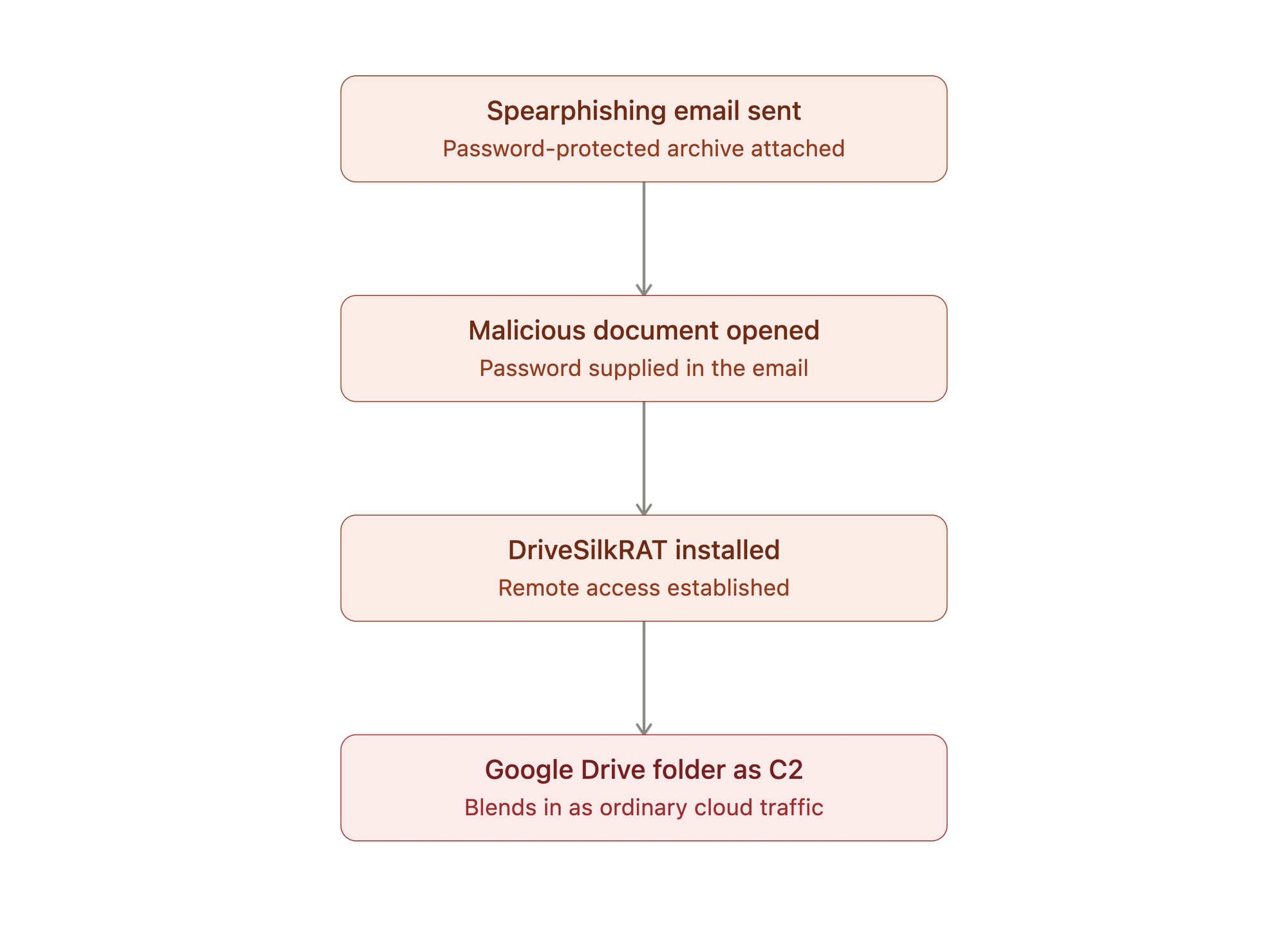
The investigation began, almost by accident, with a single suspicious infection at an unnamed Central Asian government institution involved in economic policy. What followed was nearly a year of forensic work that eventually traced a full espionage infrastructure spanning Uzbekistan, Turkmenistan, Kyrgyzstan, Tajikistan, Kazakhstan and Georgia, using malicious documents crafted to impersonate specific government ministries and agencies in each target country. The attackers' initial access method was unglamorous but effective: spearphishing emails carrying malicious Microsoft Office documents, frequently packaged inside password-protected archives with the password supplied in the email itself — a technique that complicates automated scanning by security gateways, since the payload cannot be inspected without the same credential a human recipient would use. Bitdefender ultimately identified seven distinct malware families in use, five of which had never before been documented, evidence of an operation investing in bespoke tooling rather than recycling off-the-shelf malware.
The most widely deployed of the seven, DriveSilkRAT, illustrates the operation's broader philosophy of blending in rather than standing out. Rather than communicating with a dedicated command-and-control server — the kind of traffic pattern network defenders are generally tuned to flag — DriveSilkRAT instead exchanges data through a shared Google Drive folder, disguising its command traffic as the same ordinary cloud-storage activity that fills most corporate networks and draws comparatively little scrutiny. Bitdefender recorded roughly 65 infections tied to DriveSilkRAT, concentrated in the Asia region, though the company was careful to caveat that figure as an upper estimate rather than a confirmed victim count, since a single infected machine can register more than one identifier. The company has not disclosed what data, if any, was exfiltrated from the government institution whose infection first triggered the investigation, leaving open the question of what SilkParasite's operators ultimately achieved rather than simply how they operated.
Bitdefender ultimately identified seven distinct malware families in use, five of which had never before been documented, evidence of an operation investing in bespoke tooling rather than recycling off-the-shelf malware.
The most widely deployed of the seven, DriveSilkRAT, illustrates the operation's broader philosophy of blending in rather than standing out. Rather than communicating with a dedicated command-and-control server — the kind of traffic pattern network defenders are generally tuned to flag — DriveSilkRAT instead exchanges data through a shared Google Drive folder, disguising its command traffic as the same ordinary cloud-storage activity that fills most corporate networks and draws comparatively little scrutiny. Bitdefender recorded roughly 65 infections tied to DriveSilkRAT, concentrated in the Asia region, though the company was careful to caveat that figure as an upper estimate rather than a confirmed victim count, since a single infected machine can register more than one identifier. The company has not disclosed what data, if any, was exfiltrated from the government institution whose infection first triggered the investigation, leaving open the question of what SilkParasite's operators ultimately achieved rather than simply how they operated.
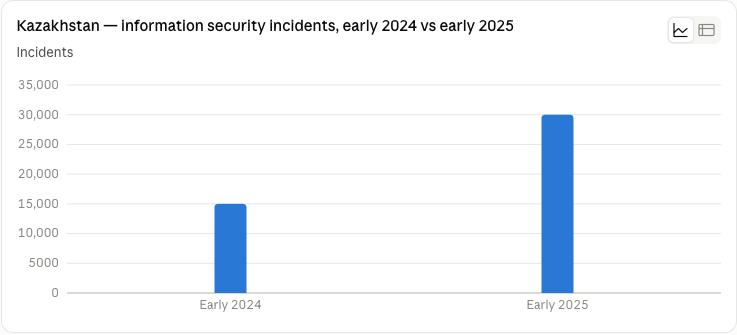
Bitdefender's case for a China nexus rests on a layered set of technical indicators rather than a single smoking gun: overlaps between SilkParasite tooling and malware previously associated with Chinese espionage groups, including infrastructure links to the previously documented FamousSparrow campaign, alongside several IP addresses traced to China Unicom's network. The company stopped short of naming a specific threat actor or asserting Chinese government sponsorship, and the campaign fits into a broader pattern Bitdefender has tracked over the past year, including separate China-nexus operations against targets in Europe and South Asia and a recent string of incidents in the South Caucasus. Martin Zugec, Bitdefender's technical solutions director, framed the strategic logic behind the targeting directly: as China's economic role in Central Asia has grown, so too has the region's value as an intelligence target — a dynamic that turns commercial expansion into an intelligence-collection opportunity almost as a matter of course. That reading gains context from Kazakhstan's own recent cyber-incident trajectory: the country recorded roughly 30,000 information-security incidents in the first months of 2025 alone, nearly double the prior year's pace, and suffered a large-scale distributed-denial-of-service attack in May 2025 that disrupted government websites, banking services and telecommunications networks. SilkParasite represents a categorically different kind of threat than that DDoS wave — not an attempt to overwhelm public-facing services, but a quiet, long-horizon effort to establish and preserve remote access inside the machinery of government itself.
What distinguishes SilkParasite from a purely conventional espionage toolkit is the campaign's documented use of artificial intelligence during malware development. Bitdefender found that at least two of the phishing lure documents were AI-generated, alongside other evidence — including telltale placeholder text left uncorrected in the malware's code — pointing to AI assistance in building several of the five newly discovered strains. Bitdefender was careful to characterize this as augmentation rather than automation: "APT-grade malware like this remains firmly the work of human professionals," the company said, describing SilkParasite as "primarily assisted" — skilled engineers using AI to move faster while avoiding the kind of generic, machine-generated code that would otherwise degrade the operation's stealth. Bitdefender's broader assessment is that capable state-linked actors will adopt AI "slowly and selectively," folding it into professional workflows precisely where it helps without introducing the "machine-made mediocrity" that would give an operation away. That measured picture of AI-assisted, rather than AI-driven, tradecraft arrived the same week the National Security Agency issued a separate, urgent warning about AI-generated exploit scripts being used against critical industrial technology — a coincidence of timing that underscores how rapidly artificial intelligence is being folded into offensive cyber operations across very different classes of adversary and target.